29 Sep, 2026
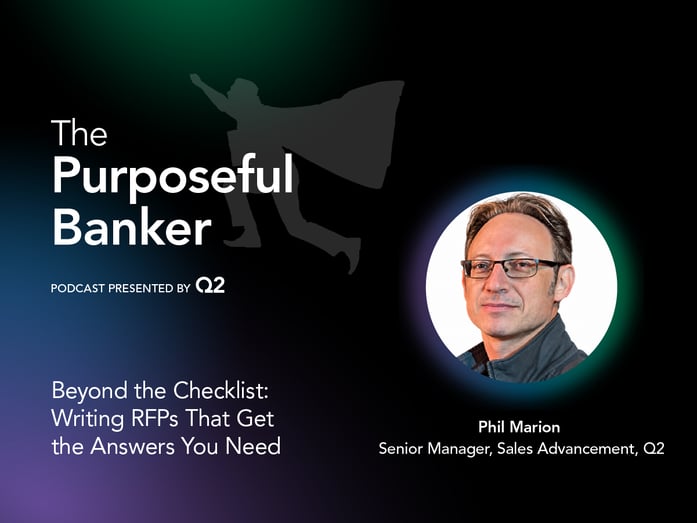
Most bank and credit union RFPs read like checklists, and checklists produce generic, unusable answers. Phil Marion, who leads Q2's proposal team and reviews about 10,000 RFP questions a month, explains why that approach fails financial institutions, and how to write an RFP that surfaces real, differentiated answers. On this episode of The Purposeful Banker, he shares practical, actionable steps for rethinking your next RFP process.
Listen
Subscribe


.png?width=255&height=116&name=Spotify_white_bg%20(1).png)
Related Links
[Guide] Your Digital Banking RFP Evaluation Guide
[Webpage] The Work of Edward Tufte
Transcript
Cheryl Brown
Hello and welcome to The Purposeful Banker, the podcast brought to you by Q2, where we discuss the big topics on the minds of today's best bankers. I'm Cheryl Brown. Welcome to the show.
Today we're talking about a document that just about every bank and credit union writes eventually, the request for proposal or RFP. Now, I've worked as a proposal writer myself in an earlier part of my career, and I understand how some people may look at this thing as a tedious, necessary evil, but today's guest doesn't look at it that way at all. In fact, at Q2, I would imagine he's read more RFPs than just about anyone, which gives him a unique view into the questions financial institutions are asking and the possibly unhelpful answers they're most likely getting.
Phil Marion leads Q2's proposal team where he and his group review, interpret, and respond to about 10,000 RFP questions every month. Phil, welcome to the show.
Phil Marion
Pleasure to be here, Cheryl.
Cheryl Brown
So first I have to know, as a former proposal writer myself, I always have to know what brings someone to this career. So tell us what drew you to this side of the business.
Phil Marion
I always say when I'm interviewing, RFP proposal writers are not made. They're born. You start like this. I began back in 1999 at the very edge of internet banking, and I had a background in adult education and art and design and creative writing. I didn't realize at the time that the RFP could encompass all of that, maybe not all of the time, however, but I was like, oh, there's a place for all of these things to gather. I became really focused even outside of work on just information design in general. And I'm going to shout out to the author, statistician, and professor Edward Tufte in his beautiful books on envisioning information. As I looked at RFP after RFP for years, I said, "My God, there's got to be a better way." And here I still am today.
Cheryl Brown
So 10,000 questions a month, your team must stay pretty busy. So tell me, what does a typical work week look like when you're that close to the RFP process?
Phil Marion
It's a healthy balance of a lot of reading, a lot of reviewing, and a lot of self-education for me and my team. I figure the more they see, the more they know. And my goal is to keep everyone on the team as educated as possible to a quickly and dynamically changing environment that we're in. So my rule is open the box. The moment you get an RFP, find out what's in there, what's the scope, how many questions, what do they need? Because early in my career, I was a one-person team. I read, reviewed, and wrote every RFP. How do I keep a whole team full of people educated as if we share some type of general knowledge between us? That's the challenge.
Cheryl Brown
Yeah. And so you didn't start out as a fintech expert, you didn't start out as a financial services expert, but now you see this from every angle, every day. I'm sure you've learned a lot and you continue to learn. So what are some of the most common mistakes you see banks and credit unions make when they're writing their request for proposal?
Phil Marion
I always like to say this for folks that haven't worked in RFPs is that there is really no way to predict what you're going to see when you open an RFP. I thought I had seen every format under the sun, but there's always another one. There's Word, there's Excel, there's portals, there are embedded documents and tables. And so because there's no standardization of the way RFPs look … and look, I don't want to criticize or reject the way RFPs look today, but I think one of the big problems is we often lose the why. There's so much focus being put on the format of the RFP, whether it's endless checklists or kitchen sinking that I think very often the banks and credit unions may be not differentiating themselves from the get-go. And so what I would say often to folks is like, look, you're trying to make a driveway, not a maze.
The harder you make it on yourself and the harder you make it on the vendors, the more difficult it will be to actually review this thing. And the whole purpose of the RFP was to have you and your stakeholders make a decision that you're confident about. Well, complexity really erodes that confidence. So that's a big part of what I see sometimes is that you've got to be thoughtful about how you write this.
And if you will permit me one analogy, which I do a lot of analogies, but buying a car, if you were to ask every car dealership, do you have wheels? Do you have a tire? Do you have a roof? It's all going to be yes. What you really need to find out is what you specifically want for your vehicle. What size of wheel? What size of moon roof? How big is the console? Can I drive off-road? What do I want to drive on my next getaway or mini break? And so I think if people start looking at the RFP as primarily one thing, help you make a decision, it might change the type of questions that you get back.
Cheryl Brown
So do you have any examples from RFPs that you've looked at recently of what a good question really looks like? I mean, it's a great analogy because we all know what we want from our vehicle, even if we don't say it out loud, but maybe banks and credit unions don't always know how to ask for what they're looking for. Do you have any examples of really good ones that enabled you to give a really good concrete answer?
Phil Marion
Yeah, they're few and far between, and I hope that that will change. But what I've seen sometimes, and it may be my gut feeling, is that somebody from outside of the industry has come in, somebody who may have been in marketing or copy editing or even newspaper or journalism, and because they haven't had the historical knowledge of what an RFP is supposed to look like, they just write in plain language, "Here's our institution. Here's the primary things that our customers or members actually wish we could do. Here's something we wish didn't happen anymore. Here's something that's a little annoying. We assume that you are a sufficiently mature business. How can you help us get from A to B?"
Those are amazing. They don't happen that often, but it gives each vendor an opportunity to really differentiate what they can bring to the table and you're not lost in a checklist of hundreds if not thousands of possible data points. You actually have a handful.
I mean, when you and I want to buy a new car or want to buy some shoes, we probably don't have a thousand things we need to know about those cars or shoes. We have five things. By isolating that, I think each financial institution finally finds out what it is that is driving the RFP. I often say, if I was advising somebody, why are you going to RFP? And whatever you're about to say to me verbally, write that down. That's the opening sentence of your formal RFP, your critical reason, your emergent event that's causing you to do it.
Cheryl Brown
Yeah. When I worked as a proposal writer, I was writing proposals for ERP systems for higher education. So public universities, these are government entities, and you would see this template come through because there's so much red tape in the RFP process, and you would see this template come through. And it was such a struggle because I knew what they wanted to know from us and there was no way to answer it with the questions that they were asking. So we would put this cover letter of sorts onto the proposal so that we could tell the story that they're really asking about. Do you find that with financial institutions, as well, where it's like they're using a template or maybe there's a consultant that has worked with them and there's a telltale sign that they've worked with the consultant because it's the same kind of questions at this other bank that also worked with a consultant? Do you see that in your day-to-day?
Phil Marion
Absolutely. I haven't actually wished that banking RFPs followed the government and military RFP format because I know why that needs to be there, but that's even more of a grid and a checklist, and actually don't mind that the RFP is a little different every time. I've been doing this long enough that I've seen my own sample RFP written in early 2000s come back to me. So somebody has taken what I wrote, it has gone out into the world and come right back to me again because I have certain tells. I'm like, "Oh yeah, yeah, that's the exact sentence I wrote in 2001. Funny that's still out there.” So I know people are borrowing this stuff and reusing it. Yes, it's a great way to save yourself some time, but I think you don't do yourself any favors by always grabbing the old RFP off the shelf. I think the hardest thing is to redefine what you need.
Cheryl Brown
Yeah. And I wonder, too, how many financial institutions just use their old RFPs as a template and things are changing. There may be questions on that old template that are not relevant anymore. I mean, do you see that? Do you see some questions that are maybe not relevant in today's technology environment?
Phil Marion
I feel like I can tell the expiration date of a question. I know a question that was written in the early 2000s, in the 2010s, just before COVID, just after COVID. There are trends, and the blessing or curse of reading 150,000 questions a year, you do get to see the trends rise and fall. There are things that straight up went away and there are things that are here to stay.
So I said earlier, I've been doing this since 1999. When I began in banking, having a fax number for tech support was still a critical item. The guy next to me in the cube would read modem strings out all day long to folks, and we would send 13 floppy disks in order to install the thick client before the browser-based version was there. And I remember floppy disks were about 144 megabytes apiece, so you did 13 disks to install a banking software on your computer.
Well, all that went away, but then something new came up, and it's usually driven by any cool new device or endpoint or payment rail. So everyone should probably remember when we thought Amazon Echo was going to be the banking tool we all used. We would tell Alexa to move money between accounts and that went away. Or what was it called? The Oculus Rift headset. Before Apple even came out with their Vision Pro, somebody asked me if we could do 3D gamification in a virtual augmented reality space. And honestly, I wanted to call them and say, "Please tell me what you envision for that. I would love to know what you think 3D banking would look like." And of course that went away, but not everything goes away. Those are kind of silly ones, but it shows you how the tech was interesting enough for it to even rear its head inside of an RFP.
Cheryl Brown
Well, and whether it's outdated or not, if the question is in there, you guys have to come up with an answer, and then the bank team that needs to evaluate the proposal, it's just creating noise, right? It's just diluting what they need to be discussing.
Phil Marion
And of course we're going to be polite about any tech request. We don't know. Maybe that is important that you have VR headset banking. We're not going to dismiss that, if it crept in. And here, let me do a quick aside. This happens all the time. I speak to a financial institution and I say, "There's this whole section of your RFP that just feels off, and out of respect for both of us, do you need me to answer this?" And they say, "I have no idea how that got in there."
And that's what I'd like to have avoided because my team spent cycles trying to figure out how to do something. Their team either may spend cycles interpreting it or realize that they didn't need it at all. And that's kind of why I'd like to see that better way come out. Maybe just the way we speak to each other could start creeping into RFPs. Not saying it has to be completely casual, but just a way where I can really clearly understand what your institution needs at this moment in a way that I'm guaranteed to be able to tell you yes or no in a way that you can make a decision. That's kind of my vision or hope for the industry.
Cheryl Brown
Well, and that's a good segue to my next question is there are questions that are outdated, but there are also some new questions that I'm sure you're seeing a lot of specifically around AI. What are the kind of questions that you're seeing that banks and credit unions are asking about some of the newer technology, including AI?
Phil Marion
I make the joke about once a week that we are all going to retire before we stop talking about AI. That is so very here to stay. Now, it might be like electricity or the phone where we're not surprised. No one says, "Hey, did you use electricity to turn your laptop on today and dial up to the internet to get to work?" No one says that anymore. Very soon we will stop using LLM and GenAI and all the fancy words and agentic. It will be part of the background noise of work.
At the moment, that is not true. At the moment, AI is moving radically quickly. It is obviously changing the architecture of many different industries, and it's wrecking some havoc in future plans. Anyone who likes to see a roadmap that goes out for two years is hard-pressed when it comes to a tool that changes on a weekly, if not daily basis.
And literally in this month, I've seen the question mature from, are you using AI—which is like, are you using electricity—to what type of AI are you using? Or how are you using AI? Or even more pointed, are you using AI for analytics or AI for fraud mitigation? And the more informed the question is, the better response you get from vendors who are significantly investing in AI, machine learning, OCR, and all these various family of tools.
So I think AI is here and I can't quite wait to see where it goes because I know it's going to become more deeply embedded in everything we do. The question is, will it be useful? When does it stop being the shiny Amazon Echo and actually become a useful piece of tech in everybody's daily life and business life?
And the other one, I think I just kind of mentioned it, mitigation of new fraud attack vectors is not going anywhere. The moment you introduce a significant technology like AI and the frontier models and everything that happened with Project Glasswing and everything that happened with Hugging Face, you now have dynamic new attack vectors, and we're all playing catch-up to see how much we can block the new and novel ways that people may be defrauded of their funds. So for me, AI and fraud is what I think about almost all the time. And if I don't get asked about it, I'm sure that my team answers it because I know it's going to be essential to Q2's clients.
Cheryl Brown
Well, and fraud is just at the top of everyone's mind, even I think maybe even more so than AI. But I do wonder, is there differentiation between a consumer RFP and a commercial-focused RFP in the kinds of questions that they're asking around fraud? Even if our Fraud Intelligence solutions aren't included in the RFP, I'm assuming they're asking those fraud questions.
Phil Marion
Yeah. I mean, despite my wish to have RFPs become simpler and more conversational, there is a reason why a consumer-focused or a commercially focused RFP has to look the way it does. I mean, different users just have different needs and it's going to change the architecture of the questions. Commercial is a perfectly fine place to have a checklist. You need to know about roles and permissions and approvals and payment types and reporting types and all the various alerts and all the integration points. Those are essential. At the consumer realm, you might be looking at more of a simple view of can it be personalized? Is it extensible to the needs of different consumers that may run smaller microbusinesses themselves? Can you stay dynamic with their needs, especially with a loss of centrality that a lot of folks have, if people are doing everything inside of PayPal and Venmo and equivalent things, how do you ensure that the consumers have a compelling reason to visit your banking app?
And so I think the fraud conversation at the bank and credit union level, it feels the same to them, but I think it feels very different to the end user. The commercial client in today's day and age is pretty sophisticated. They will go right to you and ask, "Can I get a BAI two file by name?" They will ask for an ACH SEC code by name, and they will ask if you're using something like nondeterministic fraud mitigation techniques. They're reading the articles, they're coming to their financial institution, the FI is coming to us, and that's where I feel like educating everyone across the chain is really important. And I do think of an RFP as an education device. The whole reason it landed on my desk is somebody wanted to know something. If my team obscures the reason why something works a certain way, we really haven't done our job for the financial institution.
While I'm here, and since somebody might be listening to it, I will caution against what I call the multicolumn prison, where if you have so many rows and columns of Excel that you have to scroll horizontally, if that was a physical object, if you could fall into it like a net and not get out, you might have a problem. And that's where I encourage people to slow down when it comes to gigantic matrices. I know I'm guilty of doing this myself, making matrices that are very large, but the only thing harder than writing an RFP response is reading and reviewing three to five vendors' responses. When you ask a couple thousand questions, you've really put a lot of work in front of what you need to do to make your simple decision. So that's my one encouragement at this point in the show.
Cheryl Brown
I do wonder, you described this new idea of how to write a request for proposal, and from the sounds of it, it sounds like you could maybe use AI to create the RFP in the first place, kind of get Claude in there helping you design your questions. “Here's really what I want to know,” and then maybe the AI helps you formulate those questions in a better way than the template that you've been using for 50 years.
Phil Marion
Completely agree with that, Cheryl. I've occasionally been asked to assist Q2 and prior companies I've worked at for us to write an RFP to vendors. And the first thing I do is I interview the person who needs the RFP. I try to get them out of their head and get them out of their spreadsheet and say, "Why are you even doing this? What do you need? What's most important?" And in that casual conversation when you're maybe not looking at a blank page, that's where the reality comes in. And the same way you and I would say what we want out of a car be very different then we tried to write it down.
In the age of a large language model, whether it be Claude or GPT, or if your institution doesn't have those licenses and you can use Copilot, what a great study partner an LLM can be. You can say, "Here is my role. Here's my role in the company. Here is why I'm going to RFP. Here is what I'd like to get out of the vendors. Here is what is critically important to me, somewhat important, and future. By the way, here's three recent RFPs I pulled off the shelf. LLM, please analyze them all, look for duplicates, fold them away, look for statements that are in opposition to each other, simplify it, build me a table,” and then maybe within an hour or two, you've done what would've taken you a week or two in a committee to get a minimum viable product of an RFP that literally sounds like you.
I think of all the things I do with LLMs on a daily basis, getting interviewed by them has been the biggest aha moment for me because it is much more engaging. A lot of people ask an LLM to do something and they sit back and watch it work. When you're asking to be interviewed, the LLM's making you work, and that's what keeps your brain active and that's what really gets you to that end point. So yeah, I would absolutely give that advice. Be comfortable letting an LLM interview you and make a better RFP out.
Cheryl Brown
The LLM can actually help you know what you don't know. I mean, that is one way that I work with it, like, what am I not thinking of here? What am I missing? What has changed in XYZ that I need to be aware of in this process? And so you might actually get the better answers that will help you make a better decision with your LLM.
OK, so I wanted to wrap things up with something practical here. So if a bank team is sitting down to draft their next RFP today, what's one change that would pay off for them?
Phil Marion
I think that one change is define for yourself what makes your institution unique and what you most need to get forward. Everyone knows that they need to have a certain amount of products and technology, but what are the top three things? Even limit yourself. What are the top three things that your institution needs right now that allows you to stay differentiated in your market and to your account holders, and what do you most need from the vendor? Put the boilerplate later on, put your checklist later on, but by defining your top three things of who you are today and what you need, that allows the vendor to meet you on your same terms. “Well, thank you. Here's who we are today. Here are the top three things we can do to help you.”
It also might help you get through that initial decision process. Eventually you have to winnow down your list of vendors. Why not get to that immediately versus a month or two into the process? Yeah, simplify your own ask, know thyself, I guess, to be even shorter.
Cheryl Brown
I love that. Simplify, know yourself. I love it. Well, Phil, thanks for pulling back the curtain on a process that many financial institutions only think about maybe once every few years and for the practical advice on how to make it work harder for them. Appreciate you being on the show.
Phil Marion
Happy to have been here. A reminder to all of our listeners, we're in this together, right? Let's make it easier on ourselves.
Cheryl Brown
Amen. Amen. And that's it for another episode of The Purposeful Banker. As always, you can subscribe to the show wherever you listen to podcasts, including YouTube, Apple, and Spotify, and you can find our full archive of episodes at q2.com/thepurposefulbanker. Until next time, this is Cheryl Brown. Thanks for listening.