8 Oct, 2026
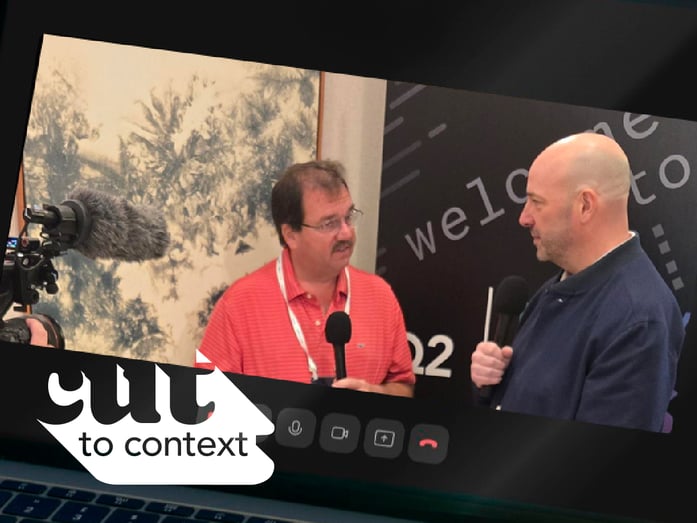
At Q2 Dev Days 2026, Adam Blue talked with four technology, digital, and product leaders from West Coast Community Bank, Forbright Bank, Citizens Business Bank, and SouthEast Bank. They share where AI is delivering value today, from fraud prevention and data privacy automation to treasury dashboards, and where they're deliberately holding back. Hear how they separate real business needs from AI buzz.
Watch
Subscribe


.png?width=255&height=116&name=Spotify_white_bg%20(1).png)
Related Links
Transcript
Hey, welcome to a special edition of Cut to Context. We are here at Q2 Dev Days 2026, where we are connecting with partners and customers and Q2 engineering and talking about the future of banking. We're going to capture some insights from customers while we're here today and then share them with you in this special edition.
Adam Blue
Hey, here with Matt March talking about some interesting thoughts on AI. Now you've been CIO at quite a few financial institutions now.
Matthew March
Quite a few. More than I choose to count.
Adam Blue
And so you've lived through how many technology cycles do you feel like?
Matthew March
Well, I've been programming since 1982.
Adam Blue
Oh, all of them?
Matthew March
Yes.
Adam Blue
All of them then. Great. So that would be Apple IIc, IBM—
Matthew March
Commodore 64.
Adam Blue
Oh wow, the C64.
Matthew March
Timex Sinclair 1000.
Adam Blue
With the membrane keyboard. I remember that.
Matthew March
Yes. I have it still in my office. It still works. I do some of my best work on it.
Adam Blue
All right. So we are in now what is historically the biggest hype cycle I think we've ever been in, the biggest real tech cycle. So as the world is starting to adjust toward being a little more thoughtful about what AI is good for, what are you guys thinking about doing? Where's the value for you?
Matthew March
Well, I think the value is in a couple fronts. So in the words of Steve Jobs, work from the client experience and work backward. I mean, ultimately that's the end goal, but there's so many opportunities organizationally, internally, externally where AI plays a big role. Fraud is a great use case and what Q2 is doing in the fraud space is absolutely amazing. And it's kind of like MAD magazine "Spy versus Spy". The bad guys have it, the good guys have it, and it's this big race. And so leveraging AI on the fraud front is absolutely incredible.
Efficiency gains on the internal side, what we're doing at the bank with some of the things with Copilot and Cowork and agentic development. We've done some amazing things just using the tools that we have. It's interesting for us because as we build tools, we built an agent for credit authorization efficiency gains. We rolled it out. We ran it for six weeks. It did great. And guess what? Our LOS came out with the same agent embedded in the workflow and the application. So we've adopted that.
So super excited to be here at Dev Days, seeing what you guys are doing. The fact that you guys have the open API architecture. I've done a lot of work in my previous banking lives at different institutions with Fiserv and FIS on their APIs. It was expensive. It was clunky. Modern platform at Q2. It's open and it's extensible. So super excited to be here.
Adam Blue
That's great to hear. Talking about working from the client experience backward, what's the one part of client experience you would really like to dig into and rethink?
Matthew March
Well, I think if you think back just in the last decade, even the last couple years, if you look at the major FIs, Fiserv and Jack Henry and FIS, the amount of money that they put back into R&D is single digits. Unlike Q2, they're putting 20% back, which is fantastic. And being in the commercial banking space, most of the core banking platforms invest most of the money on the consumer experience. And so the commercial experience has always lagged behind the consumer experience. And our commercial customers are expecting the same consumer experience and ease of use on their commercial banking platform. And we're getting that with Q2 and now having the ability to tap into the back end and extend some of the capability. It's going to be amazing.
Adam Blue
Yeah. Sounds great. All right. Thanks for joining us today.
Matthew March
Thanks for having me. Appreciate it.
Adam Blue
Here with Matt Quale talking about AI at Q2 Dev Days. So Matt, take us through maybe a couple of the use cases you guys are thinking about at Forbright Bank.
Matt Quale
Sure. We're extensively using AI and really seeing it as an enabler, both for our teammates and for our customers. I'll just give you one example of something we're doing right now is we've actually automated the CCPA process. So when a prospect comes in and says, "Can you please remove my data?" It used to be this time-consuming manual process where you're pulling information from a lot of different systems. Now we're doing is like we're pushing a button, the agent's pulling all the information, and it's really saving us hours of audit.
Adam Blue
Oh, that's fantastic. That's a really strong case. It feels like that's still very human in the loop. Is that how you would characterize that one?
Matt Quale
I'd say everything we're doing involves a human in the loop, really making the decisions. Another one we just did, which I really like, is self-healing data. And oftentimes it'll happen, this is not from Q2, but you might end up getting two SIPs come through and our data breaks down. So now what our agent does is off of an event trigger, it'll actually go in, diagnose the problem, create a fix. And then when our data team looks at it, they can actually automate and push the button to actually make the fix rather doing the investigation themselves.
Adam Blue
Yeah, that's great. I'm hearing a lot of those kind of stories where the AI is tasked with problem identification, triage, resolution, and then that last decisioning, the really accountable part, an end user, a back-office person, whatever makes that decision. That's fantastic.
So one of the other things we're starting to see now is end users maybe want to use a large tech company's AI platform to get to some of their data. And I think you guys are at the forefront of that. So talk a little bit about that.
Matt Quale
I mean, I think this kind of gets back to making sure all your data is in one place. So we currently have all of our data in a single data warehouse really across multiple systems. And what it's allowed us to do is really understand the customer journey all the way through from prospect all the way through to end. And what that's allowed us to do is understand things like when they have a good customer service interaction, what does that do to the retention? What does that do to their balance? Also helps us understand which of our marketing channels are working hardest for us. So I think the thing that's been really interesting for us is how we've been able to really make everything accessible to the team in terms of asking questions. So you want to know exactly how many deposits we had from what channel on what day and what kind of customer success they had, we can ask that question.
Adam Blue
Yeah. And so what about from the account holder perspective? What if they want to use their own AI platform tooling? I'm in Claude and I want to do some financial planning or work on taxes. How do you see that kind of unfolding?
Matt Quale
Well, I certainly think you're going to have this piece around advice that kind of sits inside the banking app where we're going to provide advice to people in terms of what they want to do. But I think a lot of it is making it accessible. So when I think about online banking or phone channel, I think actually people's agents are just going to be another channel that we're going to want to make the information accessible. And this kind of gets back to AI being an enabler and making it as easy as possible for people to get the job done they want. So one of the things I'm really excited about Q2 is the Q2 MCP in terms of being able to actually make this information data accessible inside people's agents. And we've actually come a long way with you guys in that.
Adam Blue
Fantastic. Yeah, we literally just demoed it.
Matt Quale
Yeah.
Adam Blue
So very timely. So hot off the press here at Dev Days with Matt Quale and Forbright, just talking about AI and account holders and the future of banking.
Adam Blue
Hi, I'm here with John Outwater, Citizens Business Bank. They are, you might imagine, a business-focused bank.
John Outwater
That’s right.
Adam Blue
So a lot of the conversations we have around AI and the end user, the account holder, really focus on retail. So give us a sense of what it looks like maybe when AI is a tool that you enable for a treasury department.
John Outwater
Well, for us, AI for consumers is about convenience, where am I going to be purchasing this cup of coffee or looking for something consumer in nature? For business, it's more about confidence, making financial decisions, looking at the liquidity and making important business decisions. That's where we're trying to push AI down to the business customer.
Adam Blue
That's interesting. I like that confidence/convenience trade. I do think small businesses, large businesses, mega business probably want convenience too, but for sure confidence is the lead for them. That totally makes sense. So what's a use case you guys think about that might be interesting to apply AI in that focus?
John Outwater
Well, there's two. First, and I've seen a lot of solutions here today that were actually things I wanted to talk to you about.
Adam Blue
Oh, great.
John Outwater
So it's right in line. On the backside for us, for the bank, we want to deliver more value to the customers and quicker. So Q2 Assistant is a perfect lead into that.
And all of the places that Assistant is going to be embedded, that's going to give us the ability to provide faster value to our customers. On the customer side, making those business decisions, those informed financial decisions. What's my liquidity? What exceptions are here today? A dashboard model so that they don't have to search throughout the system. We have customers with hundreds of accounts and multiple entities. So having to search throughout all of Q2 is a challenge for them. So having it all concentrated in a dashboard model using AI, that'd be fantastic.
Also, as customers are starting to live within their own ecosystems, which we talked about today, the Oracles and NetSuites, we're always looking for ways to serve them better, and they're starting to pull data from us and looking for a way to serve up those types of insights is important. How do we get that type of insight to them?
One of your vendors that you do business with, Monit, they have business insights and then they have a deeper embed where they're pulling data from Q2 to give the bank insights for the customers to have intelligent decisions at the sales level, kind of be that trusted advisor. And as we look at the data that's being provided through Monit, how do we get that in front of the customer so they can serve themselves? So that's our challenge and looking at that type of model is ultimately where we would love to go with AI.
Adam Blue
Yeah, I think it's a fascinating vision. I know I always feel like with self-service, sometimes it feels like I just work for Delta Air Lines, but a lot of the time you can get to the solution faster because you don't have to interact with someone. But then there's always that option where you say, "I'm having a problem. I'm challenged. I don't understand." And then you just want to talk to a person. So I think walking the line there I think is tricky.
And so you mentioned Q2 Assistant, which I think is a fantastic tool, helps your bankers get answers to customers faster, right? At what point, what has to be true for you to say maybe something like Q2 Assistant goes all the way to the account holder? I think we're not there yet, but I'm just curious as to what you think the gap between now and getting to that accomplishment is.
John Outwater
Well, that's actually a phase two, right? As you said, you weren't there yet. We're not there yet.
Adam Blue
Sure.
John Outwater
Customers aren't always sure what they need and having the ability to leverage AI to supplement the human experience is our critical, that's our phase one. Once we're sure that the customer's able to ask the right questions to understand the system the way that they need to, that might be a phase two where we can serve them where they can serve themselves in that respect.
Adam Blue
Yeah. I think it's a great way to think of it. All right. Thanks for being with us today, John. Really appreciate it.
John Outwater
Thanks, Adam.
Tom Vermette
So I'm Tom Vermette. I'm the CTO at Southeast Bank in Knoxville, Tennessee.
Adam Blue
So a lot of talk about AI while we're here, and you guys own a pretty good chunk of your tech stack there at the bank in Tennessee, which is fantastic. Talk a little bit about how you think about the trade-offs of what you own versus what you partner for.
Tom Vermette
So what we own is we brought our core in-house from Fiserv.
Adam Blue
Oh, interesting.
Tom Vermette
And what's nice about that is we own the whole stack. It's in our control. We're able to do a lot more without relying on a vendor to integrate, bring APIs in, make changes, workflow changes, which is great. But the challenge of that is we also have to own that responsibility. There's a lot to that and make sure that we're doing the regulatory governance security is the biggest concern that we have. So there's definitely trade-offs to both, but it allows us to be more nimble, work with our vendors and partners at our pace versus having to rely on others to help us get there.
Adam Blue
That's great. Do you think AI changes that equation for you guys at all, what you want to own versus what you partner for?
Tom Vermette
It does. The biggest thing with AI is to look at the business need. There's a lot of buzz out there about AI and sometimes they come in, they're like, "AI's the answer for everything." Well, it could be, but it's really not. So we just have to understand what is the business trying to accomplish? What's the end result? And if AI can help us get there, then it's a great solution. But we just need to make sure that there other things before AI that meet the need because you have to take the buzz out of it. But there are definitely ways to get efficiencies, but in the end you have to make sure you're checking all the boxes, you're meeting the regulatory requirements and it's accurate.
Adam Blue
Yeah. It feels sometimes like AI can be a little bit of a solution chasing the problem or at least trying to find a problem. Tell me one thing you're going to work on in the next, I don't know, 90 days that's not AI that's really important to you guys.
Tom Vermette
It's workflows, refining workflows with the business and just getting the good requirements to make sure that the end result meets the business need and it's accurate and that with development. We've got a development shop. We do a lot of development on the DNA product as well as Q2, and just making sure that what the end result is, is accurate and the most efficient for our customers and also my internal customers, which are our employees.
Adam Blue
Yeah. Fantastic. All right. Well, thanks for joining us for just a quick chat here at Dev Days. I'm here with Tom Vermette and that's a wrap. Thanks everybody.
Tom Vermette
All right. Thank you.