10 Nov, 2026
Listen
Subscribe



Related Links
[News Release] Q2 Introduces Q2 Relationship Insights and Expands Q2 Assistant Into Relationship Banking
[Webpage] Q2 Relationship Insights
[Blog] Commercial Loan and Deposit Pricing Market Update
[Blog] Making the Supercharged Relationship Manager a Reality
Transcript
Cheryl Brown
Hello and welcome to The Purposeful Banker, the podcast brought to you by Q2, where we discuss the big topics on the minds of today's best bankers. I'm Cheryl Brown. Welcome to the show.
For those of you who are new to The Purposeful Banker, this podcast has been around a long time, more than 10 years in fact. It was started back in 2015 by PrecisionLender, which became part of Q2 a few years later. And for nearly 17 years, PrecisionLender has been part of how commercial bankers price and structure deals. And this podcast once focused solely on helping relationship managers navigate the ups and downs of commercial banking.
Our focus has since expanded to all banking topics, but today we're going back to our roots a little bit. This week at the AFP conference, Q2 announced that PrecisionLender is now Q2 Relationship Insights. A name change might sound like a branding exercise, but it actually says a lot about how commercial banking has changed and where relationship banking is headed.
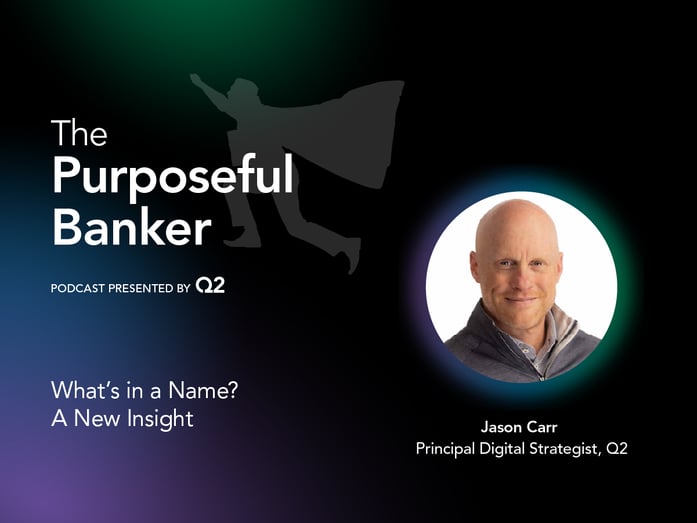
So joining me today to talk through it all is Jason Carr, principal digital strategist at Q2, and he’s spent years working alongside regional and commercial banks on relationship pricing and profitability. And if you follow him on LinkedIn, you know he has a strong opinion about the difference between growth and profitable growth, which we'll dig into just a little bit. So Jason, welcome to the show.
Jason Carr
Thank you, Cheryl. Absolute pleasure to be here and always grateful for the opportunity to contribute thoughts around helping commercial bankers be more successful.
Cheryl Brown
Well, let's just dig right into that. So let's start with the obvious. PrecisionLender, nearly 17 years of recognition in commercial banking. Why change a name that so many bankers already know and trust?
Jason Carr
Yeah, great question. Honestly, I think the simplest answer is that the product outgrew the name basically. It graduated, so to speak. PrecisionLender, as you know, started with commercial loan pricing sort of at the center of its focus. And this is still absolutely at the heart of what we do, of course. But over time, the value has really evolved to support the kind of performance engineering, if you will, that's really needed to drive disciplined profitable growth through what's undoubtedly an increasingly complex market.
And if you think about it, pricing is arguably the most important window in the commercial banking deal and relationship life cycle because it's really where strategy and capital and risk and banker judgment and of course relationship value all intersect and come together. So if you can arm bankers and other key stakeholders, leaders, treasury, finance with better insights and coaching in the moment in this really critical window, the impact really reverberates through the whole system.
And with that in mind, at the same time, the client relationships really become the fundamental unit of value. It's not individual products or deals. So today this includes deposits and treasury management pricing, and it all calls for a really forward-looking view of overall relationship value as well as things like insights from the portfolio and tailored market benchmark intelligence based on aggregated data and then ongoing reinforcement of execution and behaviors, all really designed to help people make better decisions in the moment.
So this really isn't walking away from the name PrecisionLender. It's more about giving what's become a much, much broader portfolio of capabilities a name that actually reflects this overall evolution. So the new name captures more of the intelligence and the context and perspective, especially around the relationship that really now surrounds that critical window.
Cheryl Brown
That makes total sense. So for a relationship manager who logs in to the tool every single day, what are they going to notice and what's going to stay exactly the same?
Jason Carr
I think the biggest thing they're going to notice is just the name change. So the experience of using the platform and this portfolio of capabilities and the data and the team behind it and the way they actually use it to price and structure relationships are all still there. So there's no change to pricing or contract terms because of the rename. We'll use “powered by PrecisionLender” for a certain period of time so that there's continuity.
And probably most importantly, what sits at the center of the experience hasn't changed at all. It's really banker judgment. So the goal continues to be helping bankers make better, more consistent decisions during that critical window that I mentioned previously.
What has changed over time, I should mention though is sort of everything around this critical window. The portfolio capabilities available on the platform has become broader, the relationship context is much richer, and then the intelligence and the coaching that's available have all expanded. So I describe this again as much more of an evolution of the experience than really a change in what users rely on every day. So again, biggest thing is going to be just the name change itself.
Cheryl Brown
Well, and a couple other things that aren't going to change for us here at Q2, and one is that Market Update that Anna-Fay Lohn produces every month based on the aggregated data set that we have available to us in Relationship Insights to give insights onto how bankers are pricing.
And like I said, you're pretty prolific on LinkedIn and you've made some commentary around some of the data that Anna-Fay has been able to share with us in those Market Updates. In that writing, you've pointed out that pricing volume is up, but margins are down and the positive yield curve hasn't delivered the pricing improvement a lot of banks expected. So what's going on there and what does it tell us about how banks are managing relationships?
Jason Carr
Yeah. Well, first of all, prolific is a kind overstatement. I thank you for that. Honestly, I just like to occasionally comment on things that I think might be useful. And anything that sounds like a good idea that comes from me is usually borrowed from somebody smarter than me.
But with that said, I do think the market is sending an interesting signal right now. We came into the year expecting a yield curve to provide more supportive pricing environment, if you will, overall. And instead the results have basically been mixed. So you have August pricing volume, the decline roughly 10% or so, I think. Spreads remained basically flat, and then you had funding and liquidity costs that stayed elevated. And then on the fixed rate side, you had NIM that was compressed by around 25 basis points since the start of the year.
So to me, the lesson is really that you can't simply wait for the rate environment to do the work for you. Performance has to be truly engineered, and this is where what we refer to as the Four Seasons idea becomes useful. And what this really means is it's kind of our way of describing the four recurring forces that shape relationship banking performance, and those are capital and return, liquidity, margin discipline, and then relationship depth.
All these things are always there, but depending upon what's going on in the environment, one tends to become more urgent than the others and maybe some combination of those four. And the problem is that a lot of banks still try to manage these forces, if you will, through separate teams and separate tools and maybe separate measures as well. So you might have a loan that looks perfectly acceptable to the credit team, you might have a deposit that looks different to the treasury team, and then you have maybe a treasury management opportunity that's being evaluated somewhere else entirely using a different tool and a different set of decision criteria.
And each of those decisions can look rational on its own in isolation and still produce sort of a mediocre relationship for the bank. I mean, you've got to have to face the fact that commercial banking seems like a commoditized business in many ways. The differentiating value in banking really revolves around the ability to deliver tailored ideas and insights and solution sets, of course, competitively priced to reflect that kind of differentiating value. But the point is you may have two banks that offer very comparable products, but the one that offers measurable value is the one that's going to win their relationship.
So the best relationship teams solve the client's core underlying problems or address their core goal first. So if you take working capital management, for example, with an integrated solution set, rather than selling a loan and treasury management services sequentially, usually the loan first, treasury management second, and the bank and the banker is going to try to solve for optimizing working capital management first and then lend against that gap and then use the borrower's borrowing capacity in a more optimal way relative to their problems and goals.
So this is what I mean when I'm talking about differentiating value.
Cheryl Brown
We've had Nick Koutouras on the podcast and actually he did a whole series of podcasts with us on his Beyond Pricing experience that he had as a bank leader and how finding or closing that gap between strategy and execution, how that experience worked for him. I'll share the link in the show notes for those who missed it the last time.
So that talks about, like I said, the gap between the strategy and execution. So when a commercial banking team really does manage to the full relationship, what changes for the RM in a client conversation and how does that affect the bank's results?
Jason Carr
Yeah, sure. So from an RM's perspective, I think the biggest change is that the conversation has to get broader and more strategic. And so instead of starting with “What rate do I need to win this loan,” you're starting with “What are we really trying to accomplish both with this relationship” as well as to, as I mentioned before, address the client's core challenges and goals, and then what's it worth to both sides? And then how should that influence how we structure the opportunity?
Obviously credit's still critically important. It's the beating heart of commercial banking in terms of the deployment of capital, but so are deposits and treasury management and fees and then capital and risk and wallet share and what the relationship could become over time, the relationship potential. All those things are factors. So when the RM has all of this context, they can have a much better conversation with their client. They're making trade-offs intentionally and they're bringing a more complete solution to the table.
And this is really the idea behind the supercharge relationship manager that I and others have written about using technology and insights to make the banker sharper and make them better prepared while keeping human judgment at the center.
Cheryl Brown
So let's shift a little bit and talk about AI. So one thing about PrecisionLender is that it was kind of at the forefront of AI. We had podcasts early on in this podcast where Carl Ryden, the founder of PrecisionLender, talked about Andi and how that was really an early adopter of AI before agentic AI. But you've also written that some of the AI buzz in the banking industry is just kind of hype, which I think many of us agree with you here. Adam Blue, who does our Cut to Context podcast, our sister podcast that's about AI, he agrees. Some of it's hype. But we also know that AI adoption and innovation is changing every day. So what kind of AI guidance is actually useful to a commercial banker in the middle of a structuring deal?
Jason Carr
Yeah, so the useful kind of AI to me in this context is the kind that makes a banker better at the actual moment a decision is being made. Banks are awash in data. What matters is getting that data and those insights to the moments that decisions are actually being executed, so connecting strategy and execution. Most banks already have reports and profitability systems and CRM data. It's getting that context in front of the banker while a deal is still being shaped, that's key.
And so we prefer to refer to AI as an abbreviation for applied intelligence as opposed to artificial intelligence. So what we mean by that is artificial, or excuse me, what we mean by that is intelligence that can help synthesize real data and actual configurable assumptions and business rules that align with the bank strategy to surface something actionable actually in the workflow. So a question to ask, a trade-off to consider, a pricing or structure issue to revisit, maybe even a relationship opportunity that the banker hasn't fully considered.
So I'm pretty firm on the idea that technology and AI, whether it's artificial intelligence or applied intelligence, should amplify judgment and certainly not replace it. And commercial banking, as you know, involves context and trust and negotiation and a lot of things that are really hard to reduce to a model and things that are mostly human attributes. Some of them are purely human attributes. So technology should really make bankers sharper and better performed and better prepared. The moment it starts substituting for judgment in a really complex deal, you can create basically just as much risk as value essentially.
Cheryl Brown
Well, and the AI aspect of Relationship Insights, previously known as Andi, has a new name as well, Q2 Assistant for Q2 Relationship Insights. Talk a little bit about how the Q2 Assistant piece comes in and how that's going to be a little bit different.
Jason Carr
Yeah, no, thanks for the opportunity to address this because Andi, especially for those who are familiar with Andi, is sort of the beating heart of PrecisionLender, which is now Q2 Relationship Insights powered by PrecisionLender. So Andi within the version that we knew, if you will, as PrecisionLender is now becoming part of the Q2 Assistant framework within Relationship Insights. And the focus with Andi has been on using bank-specific and defined rules and data and context to coach bankers during pricing and structuring, again, helping them make better decisions for both the client and the bank. It's all about driving outcomes. With Q2 Assistant, it's really just an expansion of this idea. So for existing Andi users, the core Andi capabilities and the custom skills, it's all going to carry forward in its current form, but the experience is going to become more persistent and conversational because Q2 Assistant will now be always on as part of the UI, essentially.
So those insights and the outcomes of the skills will be there on screen during the experience. So again, more persistent, more conversational in the workflow. And then Q2 Assistant offers a framework for adding new functionality over time and anything involving artificial intelligence will be optional in nature.
So I think about it as a broader way to deliver the same kind of contextual guidance at the point where it actually matters. And if AI, and again, I like to prefer this as applied intelligence is doing its job well in commercial banking, the banker should still own decisions. It's just with better context and better insight and kind of a clearer understanding of the trade-offs that are involved.
Cheryl Brown
So if you were advising a commercial banking leader who wants to get serious about relationship profitability over the next year, where would you tell them to start?
Jason Carr
So I'd start with something that probably sounds pretty simple on the surface, and it's getting really clear on what a winning relationship actually means for your bank. So what does good look like economically when you consider capital deployment and funding, deposits, fees, credit risk of course, and the depth and essentially long-term durability of a relationship? If this definition isn't clear, it's really hard to expect hundreds of bankers and in some cases thousands of bankers to make consistently good trade-offs against it.
And then from there, I'd make sure that relationship teams are actually aligned around the same definition. So credit, deposits, treasury management, everyone that's focused on those areas shouldn't all be optimizing different pieces of the relationship independently. They should be optimizing for the whole. And so full relationship visibility really matters and it's increasingly important as lending alone becomes less of a reliable anchor for the relationship from an economic perspective.
And then I'd also look closely at execution. So where does the bank strategy actually show up well in decisions today? And then where does it break down? Where's there a gap between leadership and actual banker execution? Are bankers getting the right context when they're pricing and structuring? And do leaders have enough visibility to coach patterns across the portfolio? Most banks have a problem with essentially turning their data into better frontline decisions if they really look at it.
And then the other part of this is I'd make this part of a repeatable operating rhythm. So you have to define the strategy and you have to empower teams. This includes, as I mentioned before, delivering differentiating value through ideas and insights and tailored solution sets, but it also includes ensuring understanding of ROI and how pricing affects that, and then making decisions, measuring what actually happened, coaching it, and then recalibrating it.
Doing this over and over is how you build something that actually holds up across those four seasons, so as conditions change. And the environment will continue to change. You're going to have capital pressure, it's going to rise and fall, liquidity's going to get harder. This is especially true with tokenization and with blockchain. It's going to make money movement much faster and easier than ever. So you're going to have margins that compress and expand for various reasons. So relationship value as the unit of value, if you will, and the depth of relationships is going to matter in many different ways. And the constant has to be discipline. And really in this context, the discipline of understanding total relationship economics and actually acting on it in the right way.
Cheryl Brown
So you meet with a lot of financial institutions and talk with a lot of financial institutions, and I'm sure that a lot of times in those conversations they say to you one of these two things: "We use a spreadsheet that works just fine to track all of our pricing decisions," or they might say, "We have really experienced relationship managers, and they just know in their gut how to price these relationships.” What do you say when you get in a room with a financial institution that gives you one of those or maybe both of those answers?
Jason Carr
So what you're really talking about and what they're talking about is anecdotes, and they're also talking about essentially old axioms. And in the current competitive environment in commercial banking with, again, a more dynamic landscape than ever, faster cycles moving than ever, and then more competition for what many banks commonly define as good relationships, the winners are going to be those that have armed and empowered their teams with the right data and context delivered in the right moment during that relationship cycle.
And this data has to be credible in nature, but it also has to be contextual and actionable, tailored around that specific opportunity and that specific relationship. And when you lack those things, you're essentially operating with blinders on, and essentially you're tying your relationship teams one arm behind their back to try and compete. You're essentially saying to your teams, "We're going to go into the market and we are not going to equip you with the best possible tools to compete because competing in commercial banking now really comes down to these moments of decision and actually executing the bank's strategy."
So I think the banks that pull ahead are going to essentially be the ones that give their bankers the context to know when growth, and not just volume, but profitable growth is worth the price and when it isn't. So you've got thousands of individual pricing and deposit and credit relationship decisions ultimately becoming a bank's results. So getting clear on what good looks like, making sure everyone is working from the same economic view of the relationship, arming them with the right tools, and then investing in an operating model that actually helps people make better decisions consistently are going to be the difference makers.
Cheryl Brown
Jason, thank you for coming on the podcast today. I'm sure you join me and the rest of us at Q2 who are excited about Q2 Relationship Insights.
Jason Carr
Grateful for the opportunity. Helping commercial bankers be better at serving their purpose is really a privilege, so I appreciate you having me.
Cheryl Brown
And that's it for another episode of The Purposeful Banker. You can subscribe to the show wherever you listen to podcasts, including YouTube, Apple, and Spotify, and you can find our full archive of episodes at q2.com/thepurposefulbanker. Thanks for listening.