29 Apr, 2026

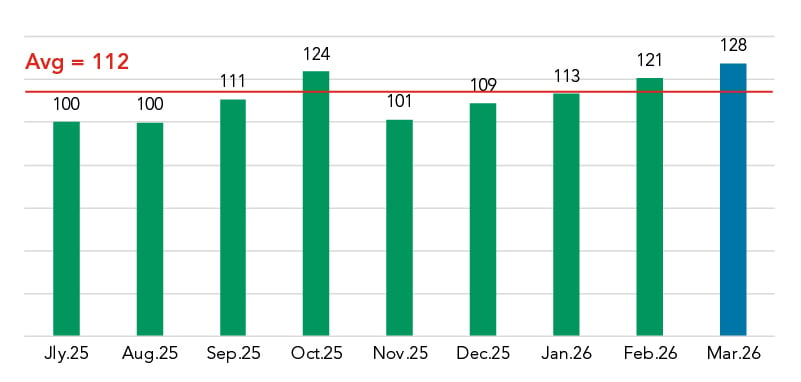
Our April analysis of the Q2 PrecisionLender commercial loan pricing looks at March 2026 activity and the strong finish to the first quarter. Pricing volume reached its highest level in the past nine months, with strength evident in both the Community and Regional+ segments.
March also brought a sharp steepening in the PrecisionLender all-in marginal funding curve. That move pushed fixed-rate funding costs higher, brought fixed coupons back into parity with SOFR structures, and changed the backdrop for fixed-rate pricing as the quarter came to a close.
Read on for more details.
Data Notes
• When we discuss the cost of funds (COF) on loan pricing activity, we refer to the marginal duration matched funding cost employed in pricing, not the bank’s actual average (historical) cost of funds.
• We define Regional+ as institutions with $8B+ in assets, while Community are <$8B.
March volume confirms a fast start to 2026
March pricing activity posted at its highest level in the past nine months, completing a fast start to 2026 in the first quarter. That increase was not isolated to one corner of the market as activity was strong across the Community and Regional+ segments.
Priced Commercial Loan Volume
Indexed to July 2025=100
The funding curve steepens sharply and inversion disappears
The PrecisionLender all-in marginal funding curve steepened significantly between the Feb. 28 and March 31 snapshots, with all rates beyond 3 months moving higher. The largest increases were in the 24- to 84-month range, which drives the marginal funding costs for fixed-rate structures. The 60-month rate in particular rose 46 points (3.52% to 3.98%).
PrecisionLender All-In Marginal Funding Curve
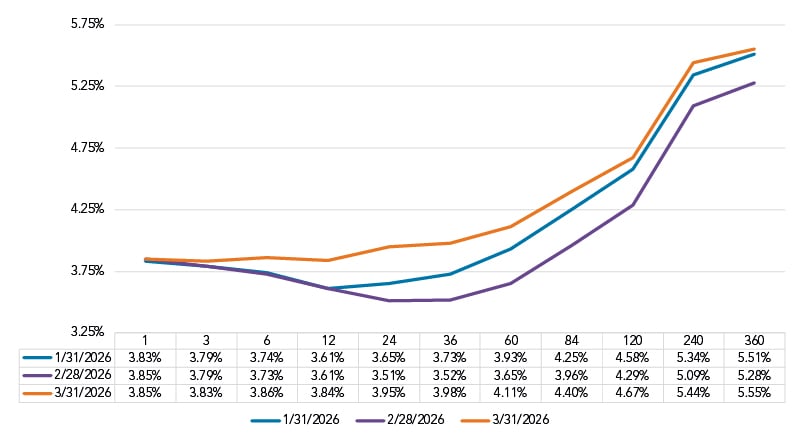
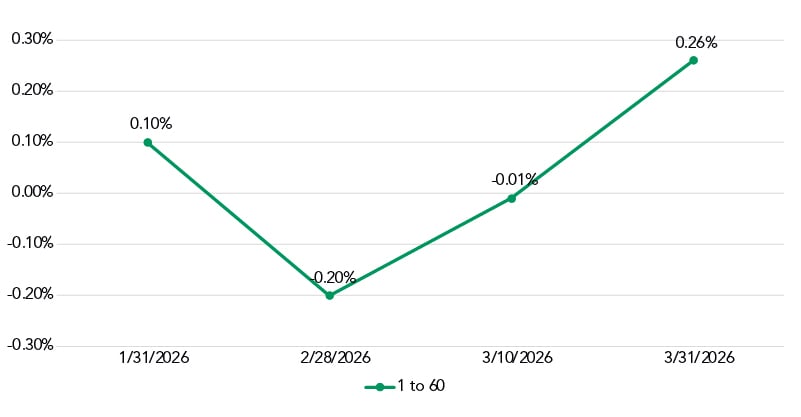
That steepening eliminated almost all remaining inversion in the curve. The 1- to 60-month carry, which had been inverted at the end of February, moved back to a positive slope of 26 bps by March 31. This is the highest slope since we began tracking in early 2023.
Curve Carry Between Common Tenors
All-in funding costs move higher on fixed-rate structures
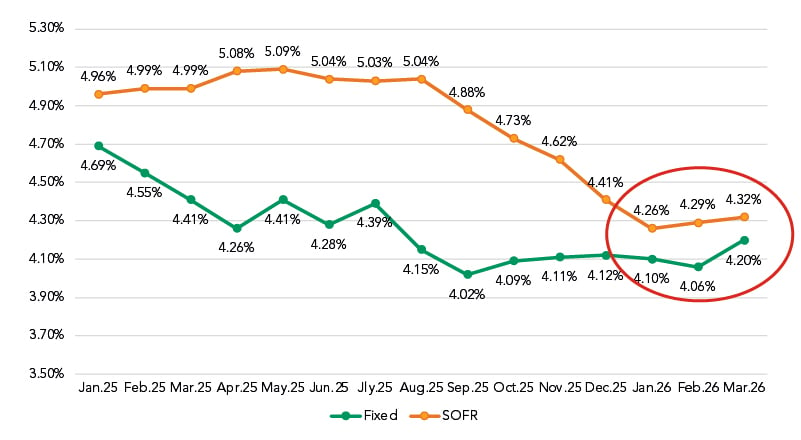
As the funding curve steepened, fixed-rate funding costs rose by 14 bps (4.06% to 4.20%) in March. The gap between the COF increase in relation to the larger jump in the funding curve rates suggests that bankers are still working to keep pace with a funding environment that shifted rather quickly.
Meanwhile, SOFR funding costs moved slightly higher in March (from 4.29% to 4.32%) but continued to be stable in in Q1 2026.
All-In COF by Month
Rolling Trend
Spreads show small signs of resilience
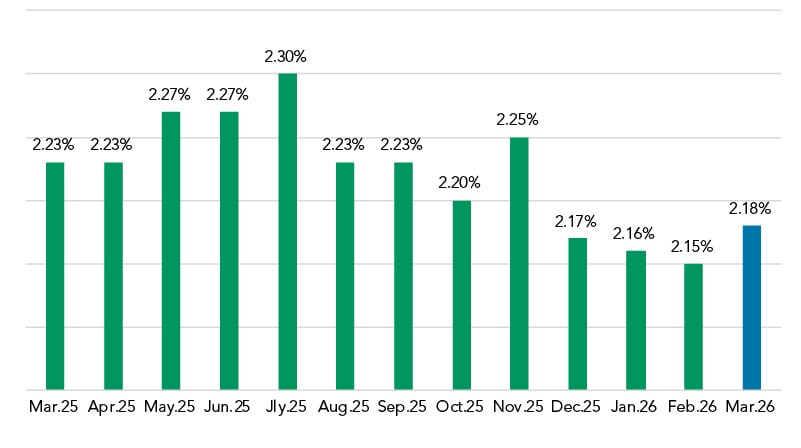
Against that backdrop, SOFR spreads improved modestly (from 2.15% to 2.18%), marking the first month-over-month uptick in four months, while Prime spreads also moved higher (+6 bps to 0.14%) and back toward the upper end of their recent range.
Weighted Average Spread to SOFR
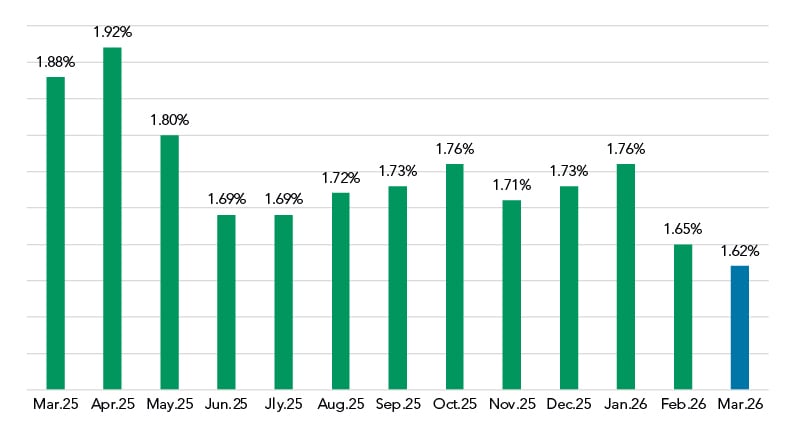
The fixed-rate coupon over COF dropped modestly in March (from 1.65% to 1.62%) as bankers largely held onto the revenue side even as their funding math became more difficult. The steeper curve did create headwinds for fixed-rate structures, but it did not lead to a break in spread discipline. Still, it’s worth noting that the spread here is down 11 bps since the end of 2025.
Fixed-Rate Coupon Over COF
Fixed and SOFR coupons converge
Since late 2025, fixed and SOFR coupons have moved into near parity, and that convergence persisted through March (5.83% SOFR coupon vs 5.82% fixed). These two structures would not typically be expected to remain in such close alignment for this long, given stable liquidity costs and a positive carry on funding curve. We will continue to monitor this in the coming months.
Coupon Rate by Month
Rolling Trend
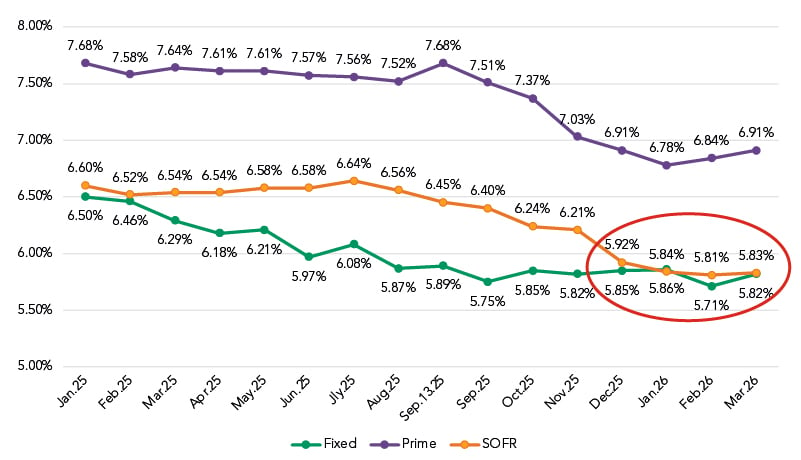
With the upward shift in the funding curve, fixed-rate coupons would ordinarily be expected to move higher if bankers want to preserve relative performance. That occurred in March, and we'll continue to monitor this to see if fixed coupons separate more clearly from SOFR in the months ahead.
NIM holds steady
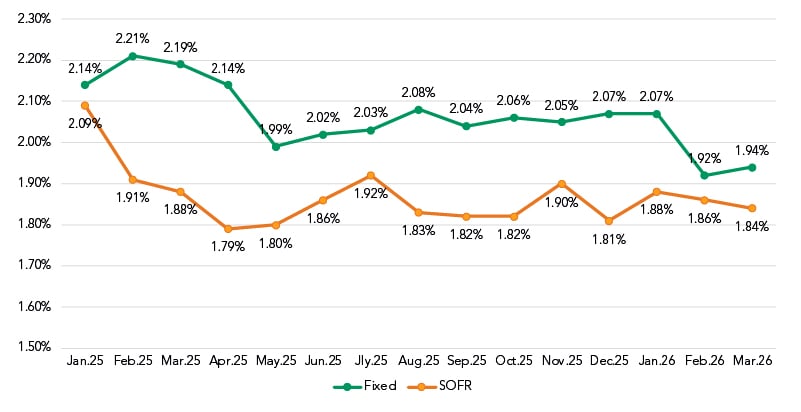
Net interest margin was relatively steady in March, though the path differed somewhat by structure. SOFR NIM was little changed (-2 bps to 1.84%), reflecting the combination of stable funding costs and only modest movement in spreads.
Fixed-rate NIM had a modest increase (+2 bps to 1.94%), which reflect bankers' ability to move coupon rates in real time with the shift in market rates. Bankers will likely face a challenge in April to continue moving the coupon higher to hold on to profitability.
Net Interest Margin by Month
Rolling Trend
Community Corner: Balanced mix and a continued revenue premium
At the end of the quarter we check in again on the Community banking segment to see how it compares to the market as a whole.
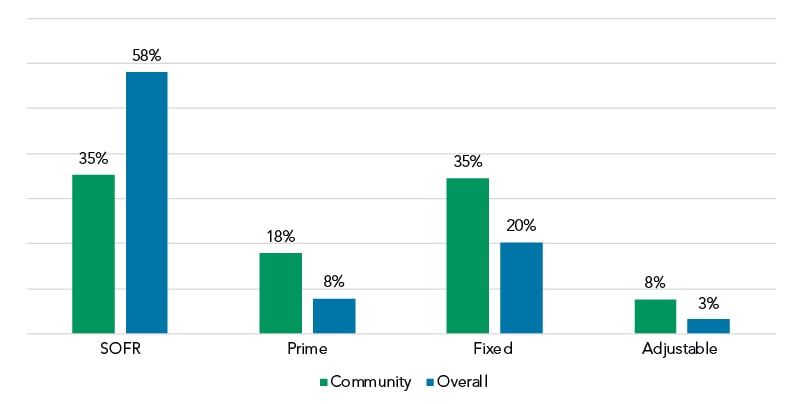
We noted that the Community mix remains more balanced between SOFR and fixed-rate structures (35% of the balance for each), while the overall market leans more heavily toward SOFR (58%) than fixed (20%). That makes the fixed-rate story particularly relevant in the community segment.
Balance Mix by Structure, Q1 2026
Community vs. Overall
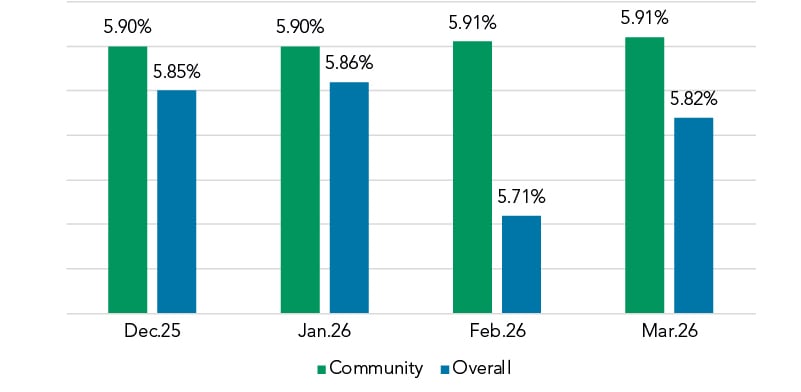
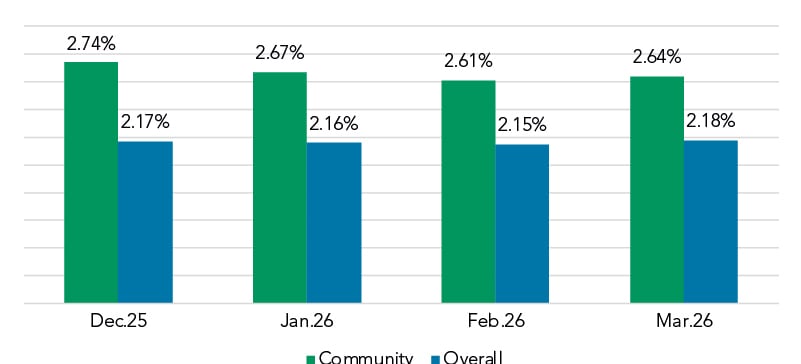
Meanwhile, Community bankers continue to price a revenue premium across structures, which is consistent with prior Community Corner updates. The fixed-rate coupon is 9 bps higher (5.81% to 5.72%), while SOFR spreads are 46 bps higher (2.64 to 2.18%) and Prime spreads are 17 bps higher (0.31% to 0.14%) The Community segment still appears to be pricing from a position of relative strength compared with the overall market.
Fixed-Rate Coupon
Community vs. Overall
Weighted Average Spread to SOFR
Community vs. Overall Market
Deposit rates remain largely unchanged
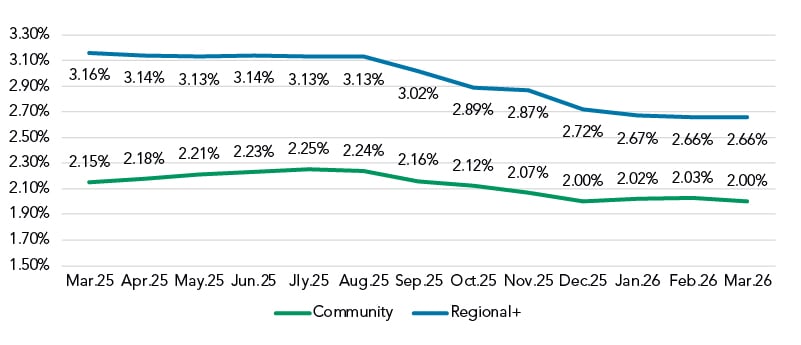
Finally, we checked in again on deposits. There was little to report in March. Interest-bearing non-time deposit rates, which we often use as a proxy for management-set deposit pricing, were essentially flat in Regional+ institutions and slightly lower in Community.
Interest Bearing Non Time (MMDA, CWI, Savings) Rate Paid
Roll-Off Watch: Q1 2026 Review
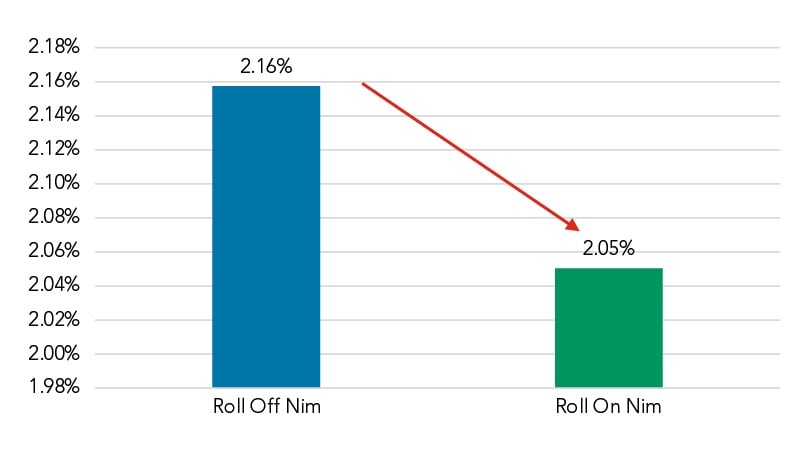
Finally, we did another check-in on how newly priced and repriced loans compare with the pandemic-era loans continuing to roll off the books. While new/repriced loans are being priced at a coupon that is 80 bps higher (5.87% to 5.07%) the increase has not been enough to match the NIM of the loans rolling off the books. (2.06% to 2.16%).
Roll-off vs. New/Repriced: Coupon
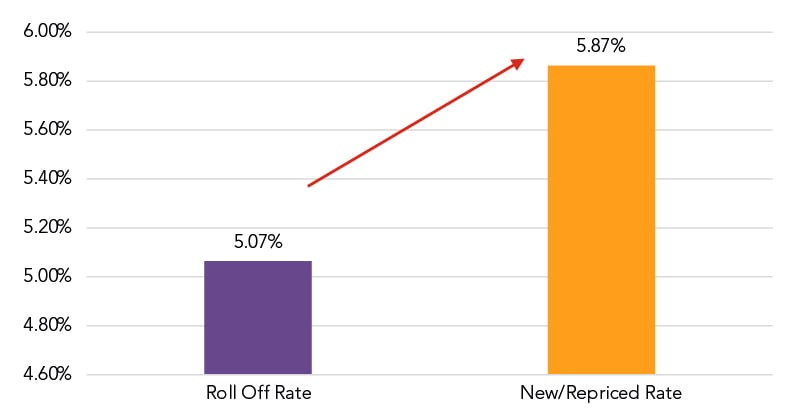
Roll-off vs. New/Repriced: Coupon
Got questions?
Our banking consultants and data scientists are combing through Q2 PrecisionLender pricing data every day. If there is anything you’d like to know about what they’re seeing, please send your questions to insights@q2.com.