24 Feb, 2026

Our February analysis of the Q2 PrecisionLender commercial loan and deposit pricing database (based on January 2026 activity) take a look and the recent shifts in the funding curves, as fixed-rate pricing appears to be adjusting to the new normal.
We also looked at the high level of pricing activity to start 2026, as well as an interesting divergence in deposit pricing between the Community and Regional+ segments.
Read on for more details.
Data Notes
-
When we discuss the cost of funds (COF) on loan pricing activity, we refer to the marginal, duration-matched funding cost employed in pricing, not the bank’s actual average (historical) cost of funds.
-
We define Regional+ as institutions with $8B+ in assets, while Community are <$8B.
Volume: Strong finish to 2025, firm start to 2026
Pricing activity posted a strong finish to 2025 and a strong start to 20265, with December 2025 and January 2026 two of the most active months start the start of 2025.
Commercial Loan Pricing Volume
Indexed to January 2025 = 100
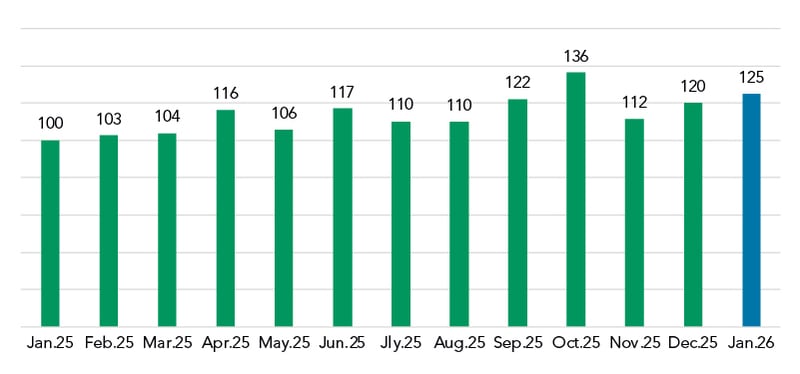
This time of year, it’s also important to call out the indexing convention. We shift the baseline forward to July 2025 so the next six months remain comparable without over-weighting new population changes. December 2025 and January 2026 pricing activity was above the average for this new 7-month period.
Commercial Loan Pricing Volume
Indexed to July 2025 = 100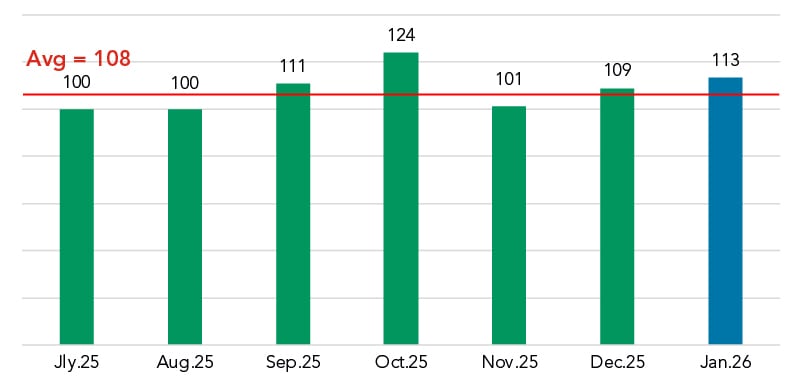
Higher activity likely indicates greater competition for deals. We'll check next month to see what impact that may have had.
Spreads: lack of resilience continues
Turning to the key revenue indicator, we continue to observe a familiar theme: lack of resilience.
SOFR spreads are flat at 2.16% month over month, after December showed a comparatively large decrease of 8 bps. Prime spreads slipped 5 bps to +4 bps to the index. Both remain below their levels before the Fall rate cuts.
In our recently released State of Commercial Banking report, we noted that the Federal Reserve Survey of Senior Loan Officer reported expectations for declining margins, and spreads to index are a contributing factor. Our data shows that spreads have continued to trend lower since the start of 2025.
Weighted Average Spread to SOFR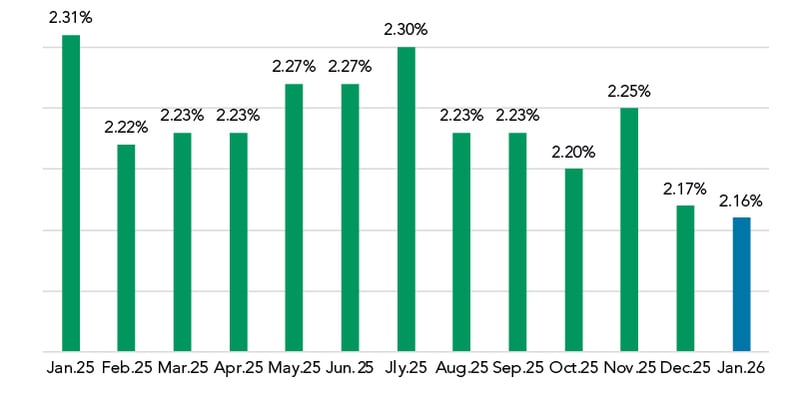
On the fixed-rate side, spreads have been in the ~175 bps range for several months. They remain down since the start of 2025, though up from the low of 169 bps in June and July.
Fixed Rate Coupon Over COF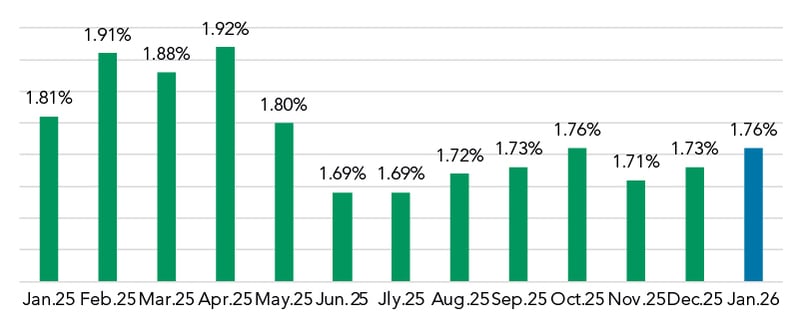
That overall drop may be an indication that bankers aren’t fighting to maintain coupon rate levels. Note that during the past 12 months, the gap between the coupon and the 60-month rate on the FHLB curve has shrunk by nearly 30 bps.
FHLB 60 Month vs. Fixed-Rate Coupon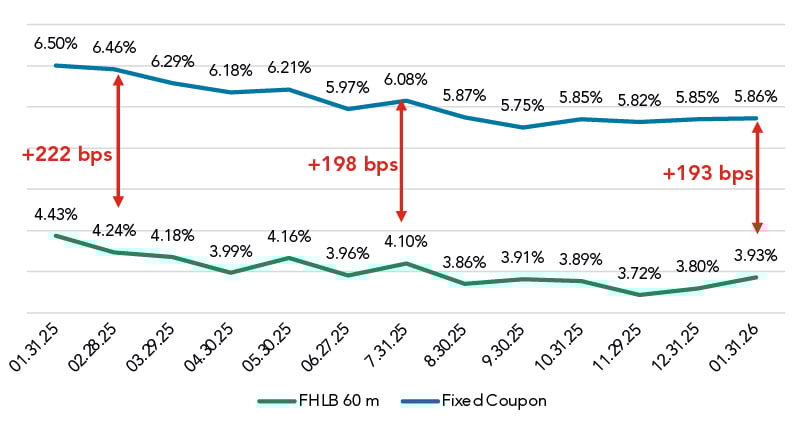
Taken together, the spread picture still reads like a market with ample liquidity and plenty of competition.
Funding curve: positive carry returns
The curve setup has changed materially since we las reported it on in our December 2025 update. With the exception of a small trough between the 3 and 60-month tenures, very little inversion remains. Since year end, the 1-month rate was virtually unchanged at 3.82% and the 60-month rose 13 bps (3.80% to 3.93%) during that span.
FHLB Curve
Selected Dates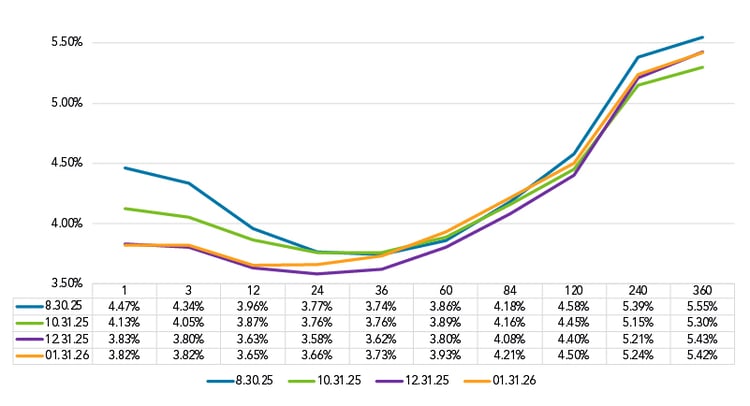
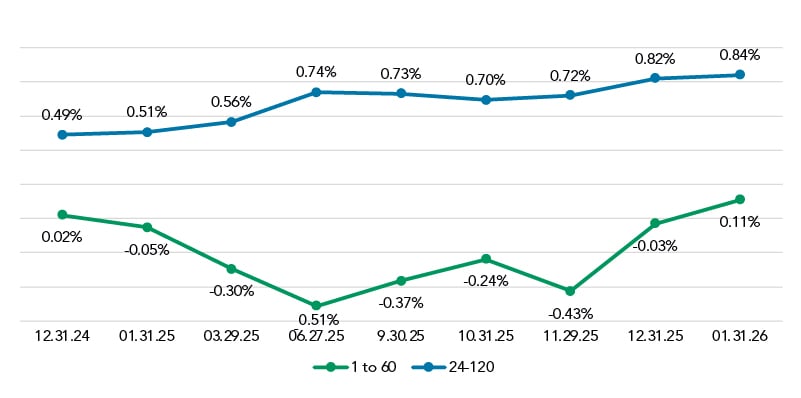
As a result, there is a positive carry of 11 bps from the 1-month tenure to the 60-month tenure, the two key points for pricing. That’s the first time that metric has been positive since it was +2 bps in the December 31, 2024 snapshot.
FHLB Curve Carry
Between Common Tenures
Cost of funds: SOFR and fixed-rate costs converging
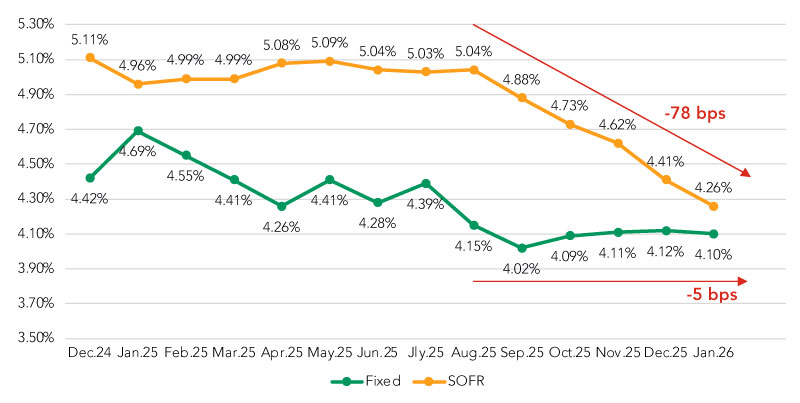
SOFR funding costs largely reflect the trio of rate cuts since September 2025, as they have dropped 78 bps from August 2025 (5.04%) through January 2026 (4.26%). Meanwhile though, fixed-rate COF All In have remained steady during that span, dropping just 5 bps (4.15% to 4.10%) The 89-bps gap between SOFR COF and fixed COF in August has thus closed to just 16 bps in January.
All in COF by Month
Rolling Trend
Note: Beginning next month, we will transition to a Treasury based funding curve proxy in response to changes in the availability of FHLB curve data.
Coupons: fixed and SOFR move toward parity
Not surprisingly, as the funding inputs have shifted, so too has the coupon story. Fixed and SOFR coupons are reaching parity again, with the SOFR coupon (5.84%) dropping just below the fixed-rate coupon (5.86%) in January.
Coupon Rate by Month
Rolling Trend
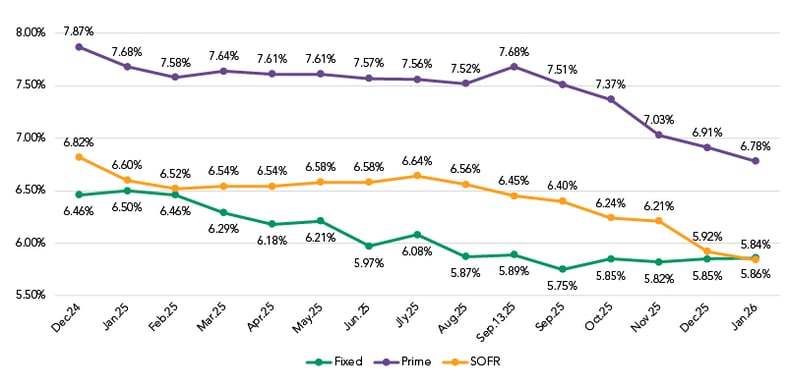
When coupons converge, the fixed-vs-floating choice becomes less about “rate gap” and more about structure, term preference, and optionality. We will continue to monitor structure preferences and potential shifts in mix.
Liquidity costs remain range-bound
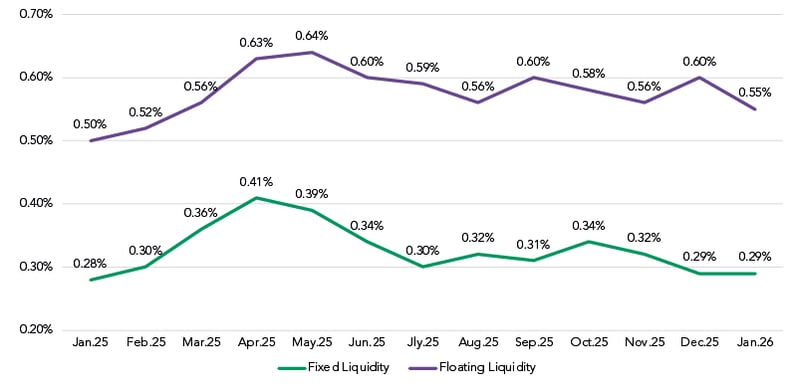
Liquidity costs remain in the same tight range they’ve been in since before the rate cuts. Floating-rate (SOFR) liquidity costs are at 55 bps, at the low end of their 6-month range (55-60 bps). Fixed-rate liquidity costs are at 29 bps, also at the low end of their 6-month range (29-34 bps).
Approximate Liquidity Cost
Rolling Trend
NIM improves on SOFR
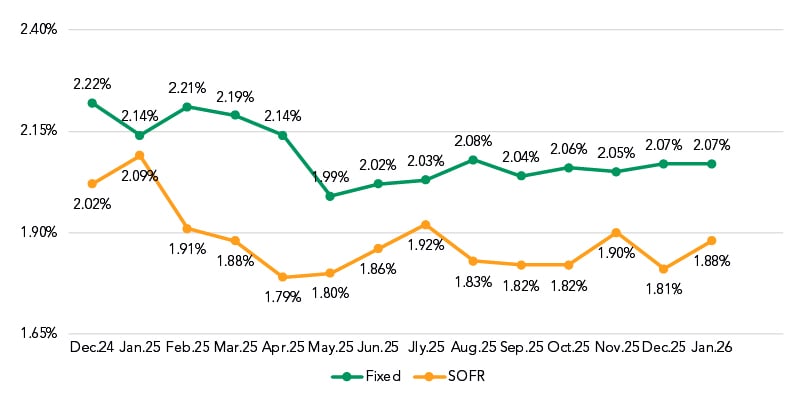
The drop in funding costs helped boost SOFR NIM by 7 bps in January (1.81% to 1.88%). Fixed-rate NIM stayed steady, mirroring the lack of recent movement in funding costs and the coupon.
NIM by Month
Rolling Trend
Deposits: Divergence at the segment level
Since we last checked in on deposit rates, they have continued to drop, which was expected given the December rate cut occurred during that span. During the recent SOCB webinar, many participants reported that deposit liquidity would be a cornerstone of many 2026 business plans, due to both its increased availability and lower trending cost.
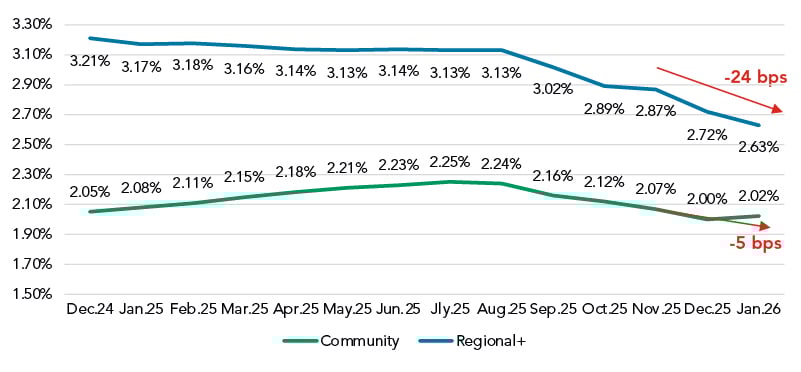
What caught our eye though was that the rate of decrease differed between the Regional+ and Community segments in their interest-bearing non-time portfolios—a proxy for management-set rate decisions Our data shows that Regional+ institutions have lowered rates in those portfolios by 24 bps since November (mirroring the quarter-point rate cut), but the Community counterparts have only dropped rates by 5 bps during that period.
Interest Bearing Non-Time (MMDA, CWI, Savings) Rate Paid
Roll-Off Watch series: 2025 wrap-up
We’ll finish up by returning to Roll-Off Watch to see what happened in Q4 2025 and what that means for 2025 overall.
A reminder this was a look at how coupon rates and NIM for pandemic-era loans rolling off the books in 2025 compared to loans that were being newly priced/repriced in 2025. Below are our rules of the road for this analysis.
-
The KPI will be the degree (+/-) to which original NIM compares with NIM for new and renewed loans. It is not a record-for-record match of matured loans and their replacement attributes.
-
Using the December 2024 portfolio snapshot as the basis, we’ve aggregated 2025 roll off activity by quarter and presented static coupon measures associated with each quarter.
These values may change as 2025 progresses due to early payoffs, curtailments, or other activity.
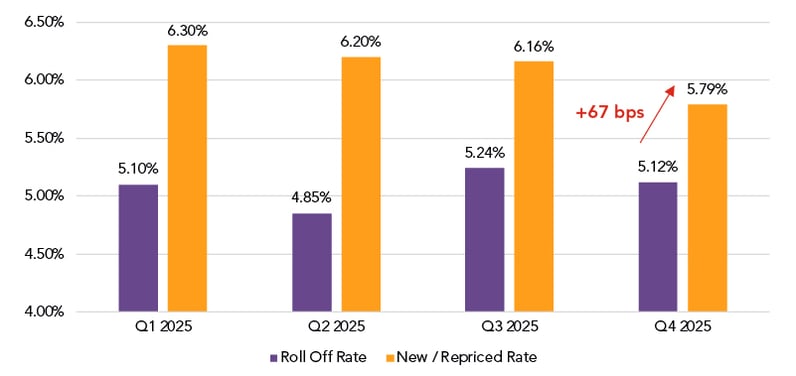
For the year, the new coupon lift was ~104 bps over the rates on loans rolling off. However, that gain eroded over the course of 2025, from a +120 bps coupon gain Q1 down to 67 bps in Q4.
Roll-off vs. New/Repriced: Coupon
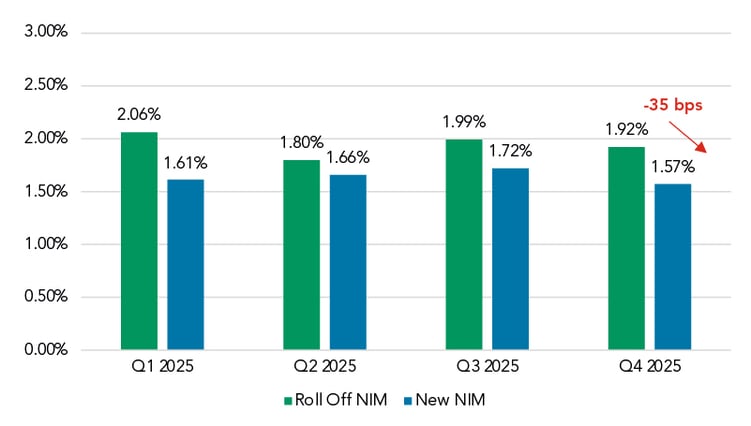
Meanwhile, NIM measures fell short by about 30 bps for the year from the roll-off level to the new (replacement) level.
Roll-off vs. New/Repriced: NIM
What we’ll be watching for in future updates
With pricing activity still firm, it will be interesting to see if bankers use these tactics to protect performance in the coming months.
-
Using guardrails. Actively acknowledging key revenue measures such as contractual spread, fee income and cross-sell adders.
-
Being intentional about structure. Coupon parity changes borrower conversations; it could be a catalyst for more structure-driven negotiations.
-
Tracking sources of funds and their costs. Overall, deposit repricing trends vary across institutions. Budgets in 2026 may hinge on execution cadence as much as strategy.
Got questions?
Our banking consultants and data scientists are combing through Q2 PrecisionLender pricing data every day. If there is anything you’d like to know about what they’re seeing, please send your questions to insights@q2.com.