23 Mar, 2026

Our March analysis of the Q2 PrecisionLender commercial loan and deposit pricing database looks at a February market that remained active, even as fixed-rate pricing weakened materially.
Bankers gave up meaningful fixed-rate coupon and spread during the month, despite relatively stable funding costs and deposit costs.
We also take a look at the new PrecisionLender all-in marginal funding curve, which shows that the modest inversion seen at the end of February had largely disappeared by a March 10 snapshot.
Read on for more details.
Data Notes:
-
When we discuss the cost of funds (COF) on loan pricing activity, we refer to the marginal duration matched funding cost employed in pricing, not the bank’s actual average (historical) cost of funds.
-
We define Regional+ as institutions with $8B+ in assets, while Community are <$8B.
Volume: Pricing activity remains strong
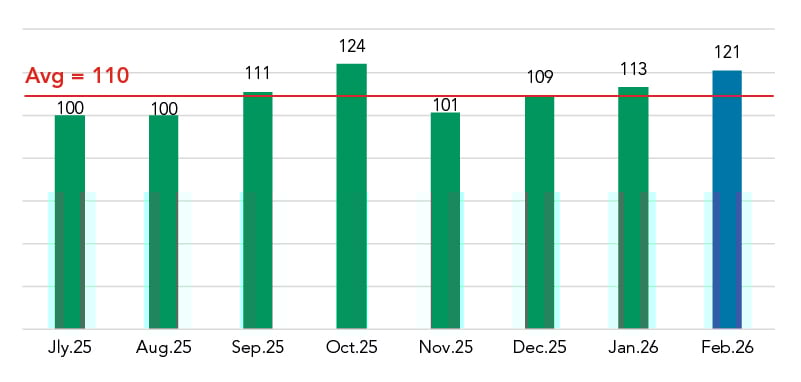
February pricing activity continued to build on the strong start to 2026. February volume was well above the July 2025 baseline of 100, at 121, and above the average of 110 over the past eight months. Most of the increase was driven from Regional+ institutions than from Community banks.
Priced Commercial Loan Volume
Indexed to July 2025 = 100
 Fixed-rate spreads: Performance drops sharply
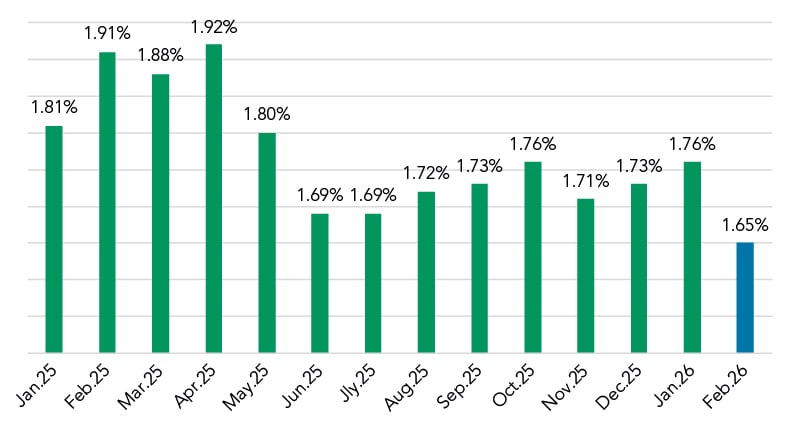
The clearest story in February was the drop in fixed-rate spread. The fixed-rate coupon over cost of funds fell to 165 basis points (bps) from 176 in January, the lowest reading since March 2023.
Fixed Rate Coupon Over COF
Floating-rate spreads: Stable month-over-month
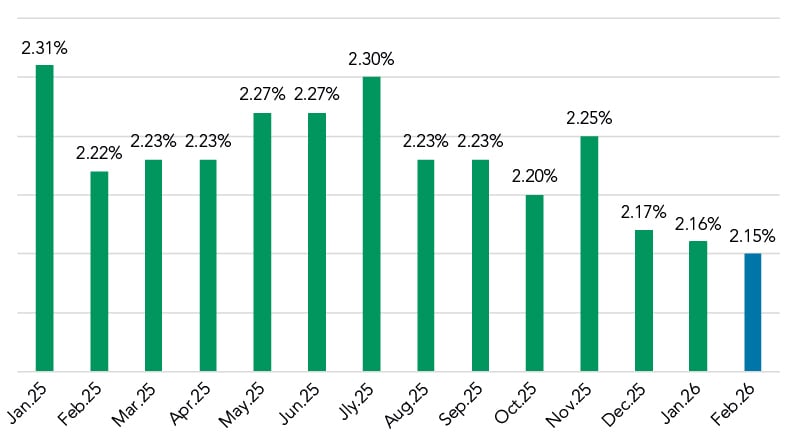
Meanwhile, floating-rate spread performance was more stable. SOFR slipped to 2.15%, while Prime added 4 basis points to 8 basis points over the index. The February story was not a broad-based deterioration across every loan structure. Instead, the sharpest movement showed up in fixed-rate pricing, where bankers gave up materially more coupon and spread than in floating-rate structures.
Weighted Average Spread to SOFR
Funding curve: Early March reverses the February dip
This month we’re using an all-in marginal funding curve. With FHLB advance rate information no longer publicly available,[JY2.1][AW2.2][AW2.3][AW2.4][JY2.5] this all-in marginal funding curve curve is based on U.S. Treasury plus estimated, historical, average borrowing spreads across the term structure.
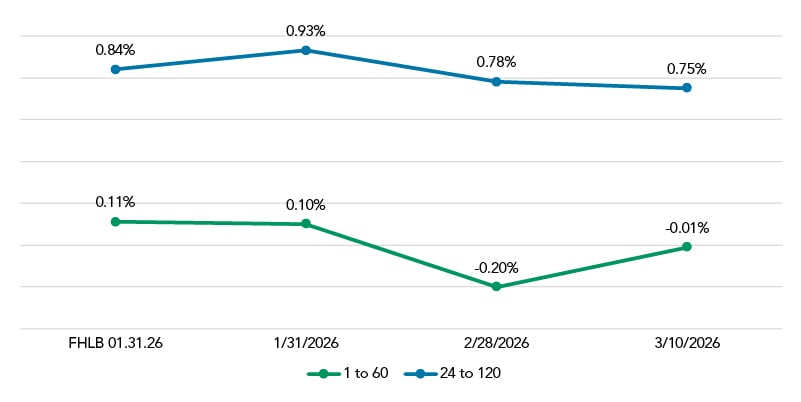
We’ve posted the January 31 data points for the last FHLB curve, along with the approximated all-in marginal funding curve: Note the consistency between the two.
PL All-In Marginal Funding Curve
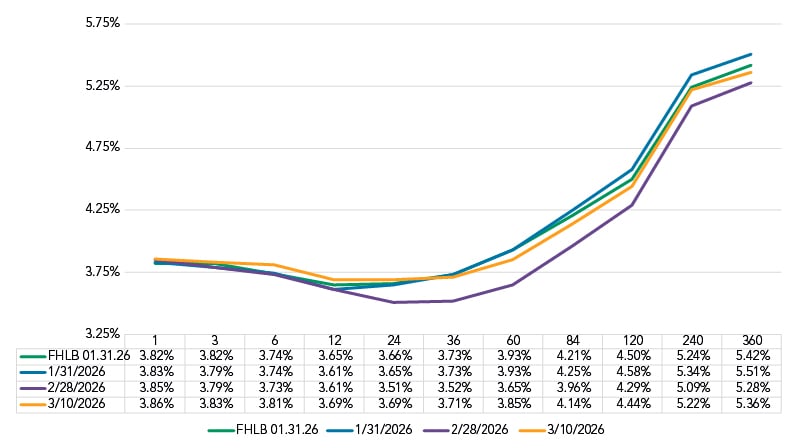
At February month-end, the curve showed a modest inversion. By the March 10 snapshot, that inversion had largely disappeared, and the 60-month point had moved about 20 bps higher. That shift means that in our next market update we will be looking to see whether bankers are able to recover any of the ground they gave up on fixed-rate pricing in February.
Curve Carry Between Common Tenors
All-in COF: Funding costs remain steady
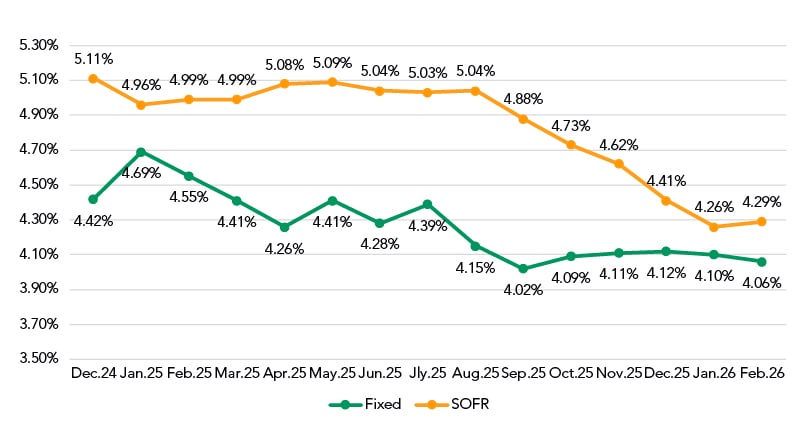
Despite the movement in the PrecisionLender curve, all-in funding costs remained stable overall during February, as SOFR COF added 3 bps to reach 4.29% while Fixed COF fell 4 bps to 4.06%. The change in SOFR COF is the smallest since July to August of last year and fits with the context of no rate cuts and with no rate cuts and overall little change in short-term interest rates.
All-In COF by Month
Rolling Trends
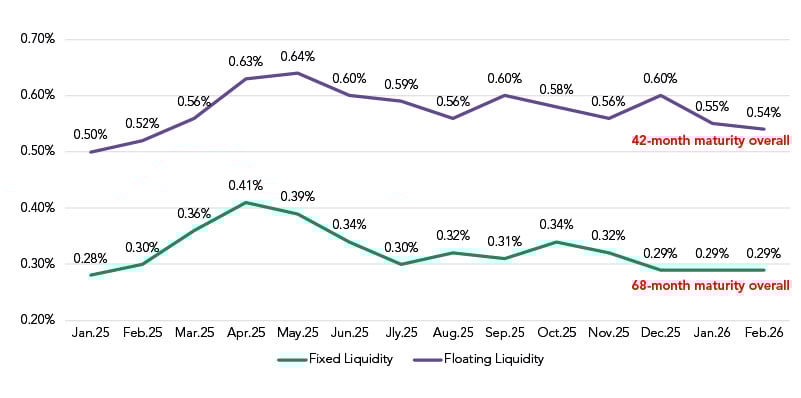
Liquidity costs stayed in a narrow range, as the costs applied to lending have been nearly unchanged thus far in 2026. As we’ll show later, deposit costs were also nearly unchanged month over month. That steadiness appears to undercut the idea that the fixed-rate spread decline was forced by funding pressure.
Note: We also added the current weighted maturity measure to this chart.
Approximate Liquidity Cost
Rolling Trend
Coupons: Fixed and SOFR diverge
Coupon performance is where February down shift in fixed-rate spreads shows up. SOFR coupons moved slightly lower, by 3 bps to 5.81%, while fixed-rate coupons dropped 15 bps to 5.71%. Again, it seems fixed coupons dropped without any noticeable pressure to do so.
Coupon Rate by Month
Rolling Trend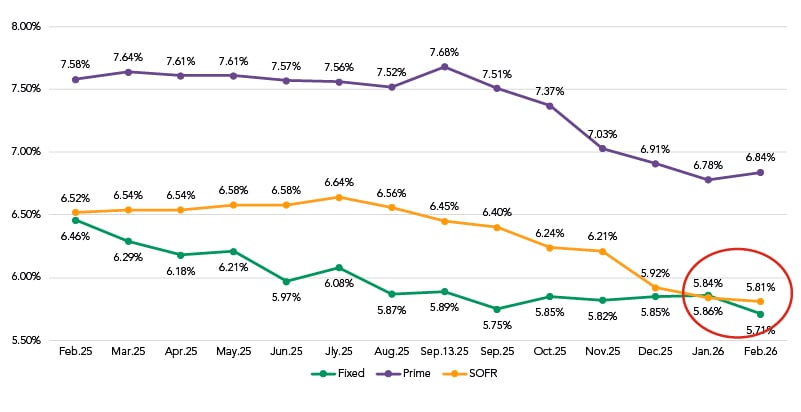
NIM: Fixed-rate profitability softens further
Not surprisingly, the lower fixed-rate coupon translated into lower fixed-rate profitability. Fixed-rate NIM moved lower on the fall in coupon, while SOFR NIM changed very little.
NIM by Month
Rolling Trend
Deposit rates paid: Quiet overall, but still divergent by segment
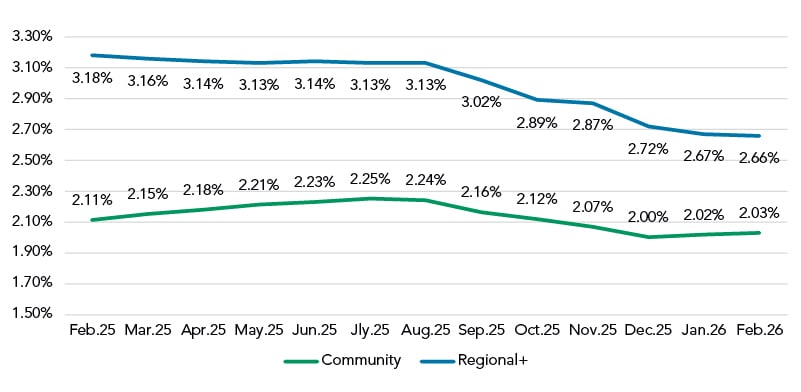
There was no major deposit story in February at the aggregate level. Deposit rates paid showed no material change from January to February.
Still the segment divergence remains worth noting. Community rates on interest-bearing non-time deposits ticked up again slightly (from 2.02% to 2.03%) while Regional+ rates dropped from 2.67% to 2.66% remained flat.
Interest Bearing Non-Time (MMDA, CWI, Savings)
Rate Paid
Roll-off 2026: A bigger story still ahead
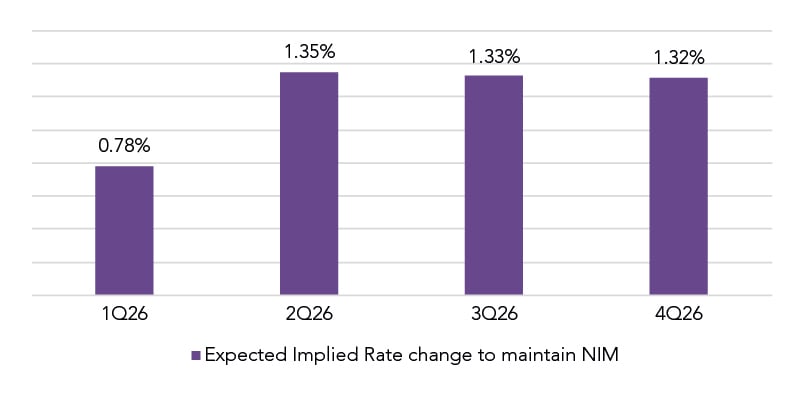
Looking ahead at the new/repriced vs. roll-off comparison for 2026, the expected roll-off coupon rate averages 4.78% for the year, which implies a required rate lift of ~120 bps on fixed-rate deals priced in 2026 to maintain NIM.
Expected Roll-off Rate
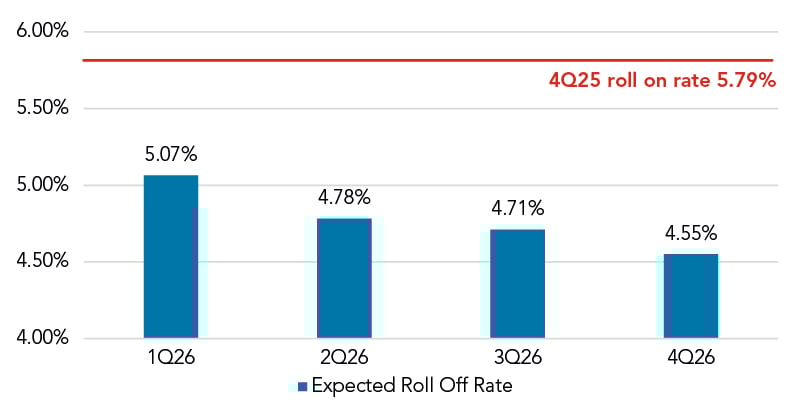
The coupon gap to current levels is larger in quarters 2-4 of 2026 than what we observed in 2025. In terms of the timing of the roll-offs, each quarter in 2026 represents about 25% of balances expected to roll off during the year. Finally, the implied coupon lift needed to maintain profitability levels rises above 130 basis points in the final three quarters of 2026.
Expected Implied Rate Change to Maintain NIM
Any questions?
Our banking consultants and data scientists are combing through Q2 PrecisionLender pricing data every day. If there is anything you’d like to know about what they’re seeing, please send your questions to insights@q2.com.