9 Jul, 2026
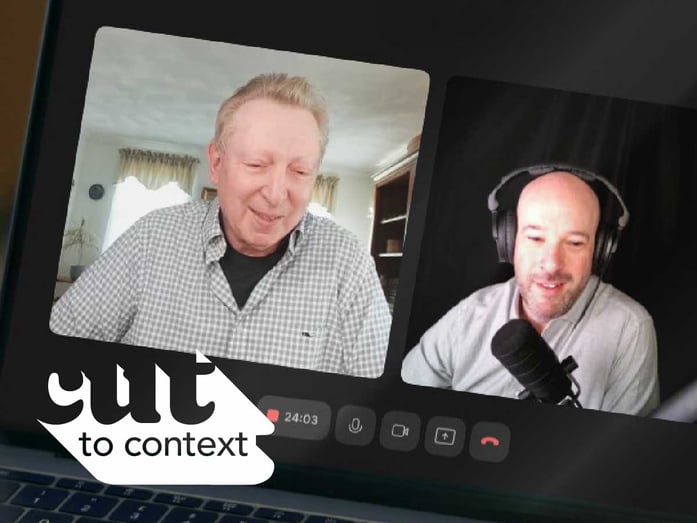
Nearly half of all banks and credit unions have deployed generative AI. So why isn't anyone measuring it? Adam Blue sits down with Ron Shevlin, chief research officer at Cornerstone Advisors and author of the Fintech Snark Tank, to dig into the gap between AI activity and AI impact at community institutions. The conversation takes an unexpected turn through Rick Rubin, Link Wray, and a beat-up Cadillac in Brooklyn, and lands somewhere more interesting than the data alone.
Watch
Subscribe


.png?width=255&height=116&name=Spotify_white_bg%20(1).png)
Related Links
"The Creative Act: A Way of Being" by Rick Rubin
Transcript
Adam Blue
Hey everyone, welcome to this week's Cut to Context. I'm really excited today to be joined by a fintech hero and a personal favorite of mine to read his pieces. We've got Ron Shevlin. I've been following the Fintech Snark Tank for quite a while. You can view current versions of it on Substack, where Ron publishes.
I think even more than the Snark Tank, I just love reading Ron's random comments on LinkedIn posts. LinkedIn is so full of total nonsense and there's just a certain amount of realism every time I catch a Ron Shevlin zinger that I really, really enjoy. So thanks for being on today, Ron. I really appreciate it.
Ron Shevlin
Well, thanks for having me. Thanks for the kind words. We could probably spend a good hour just talking about LinkedIn and what we could do to make that better, huh?
Adam Blue
At least an hour. But let's talk about something interesting instead. So I've mentioned this a couple times, but I studied graduate economics, which gives you a really weird view of the world. And as a failed economist, I'm always bumping up against things that I feel like I learned in grad school, you know, and did the math for that other people sometimes overlook, and one of these is this fascinating conversation we have all the time about elasticities, right?
And so someone will say, you know, if we drop the price on that product, I bet we'd sell so many more units. Someone says, no, if we drop the price, we're just giving away margin. We're not going to get that kind of leverage. And it all comes down to this kind of difficulty in measuring the elasticity, right? No one really knows what their price elasticity of their product is because it's a very difficult thing to capture.
And I feel like we're a little bit in the same kind of place with AI, right? So you can tell two stories about AI and community banking and regional banks. And you could tell a story where they figure out a way to move faster and become more flexible and they utilize their deep customer relationships and become really, really valuable and grow fast and make up ground. And then you could tell another story where the elasticity cuts in the other direction and large institutions take advantage of AI and AI capabilities and really put a lot of pressure on, you know, community banks, regional banks that are operating today.
And like so many other stories we tell ourselves, it all comes down to what you think the relative elasticity is on technology spend and the ability to move fast. So where do you come down, Ron? What do you think it looks like right now?
Ron Shevlin
Well, you just introduced a really interesting concept of elasticity and which measures is impacted by supply and demand. And for an established market, you can predict what the demand for a product, how it will move up or down based on the impact of the price.
But Adam, I think we're dealing with a market here or a set of a product or set of products and services for which there is no established pricing or no well measured or quantified demand just yet. I think what's happening is we're asking financial institutions to place a lot of faith in some new technology that's going to create some benefits for them. And there is history in well, we've got 50, 60, 70 years of proof that make investments in technology can prove can pay off in terms of improved productivity, lower cost, faster process time, or even improved products and demand for the products and services when technology is either creating or delivering or embedded into those products and services.
We're at an inflection point. This is not all that different, by the way, from 45-ish years ago when PCs started hitting people's desks. You know, I'm the old guy in the room, again, and nobody remembers back then when economists argued about whether or not personal computers impacted productivity. And the problem wasn't that they didn't impact productivity. The problem was that it wasn't ever measured. So you know I always used to say if you want to see if personal computers are having any impact, shut them down one day and see how much work gets done.
And I think we're in a very similar situation today with AI. A lot of the usage is personal tools, ChatGPT, Claude, Gemini tools like that. Copilot. And a lot of folks are using those tools to improve the speed, the quality, the time of what they do. They're not embedded into enterprise systems just yet, except for things like machine learning in fraud detection, fraud management, and loan underwriting.
But we're asking financial institutions to place a lot of faith in the return that they're going to get for technologies that, Adam, I don't think they understand. And I think that's one of the problems. I did a post on this a couple weeks ago and I took a lot of the AI vendors to task for talking all about the benefits and the impact but not explaining exactly what the technologies do. And I think this is the big challenge of a lot of financial institutions right now.
The other challenge I'll throw in there and get your take on this is, you know, I do a survey every year, What's Going on in Banking. I ask senior executives where is AI, generative AI, agentic AI being used in your organization. And I ask it function by function. The functions with the highest use of generative AI are the predictable places: fraud, loan underwriting, and customer or member service.
Adam, this is delusional thinking on their part. Everybody is using it. Everybody in every function of the organization. So it's a measurement, it's an awareness problem, an issue. And I think this is one of the biggest challenges that senior execs at banks and credit unions have to deal with right now.
Adam Blue
Yeah, I think that's an interesting way to think of it. Fundamentally we know that the use is pervasive, right? Even if it's not sanctioned, because it's tough to get people not to use AI if they think they can, you know, get some leverage out of it. Well one of the things I see a lot is that employee adoption is so driven by where the surplus goes, right? And so as an employee, if I feel like I get to keep some of the surplus, I can spend more time doing something I enjoy as part of my job by using AI. I can get some things done faster so that I don't maybe have to work as long. I can eliminate some amount of having to coordinate with another team by just doing it myself with AI.
These are the things that kind of drive a lot of what I see in adoption. And I think a lot of the early adoption is very, it's very personal in much the same way that I think the PC and personal computers were. I do believe if you went in and you just locked everybody out of using AI, even today at the financial institutions that we serve at Q2, there would be an impact. But I don't think it would be an enterprise-level impact. I think it would predominantly be sort of a scattered personal impact. But I do think on the horizon there is a view of the world where AI gets used in a way to really change the context that you can capture around the customer and the customer relationship. And I think that could be pretty formative, pretty fundamental.
But I don't think it happens in the next 12 months. I think we start to lay the groundwork in the next 12 months, and it takes a long time to pay this thing off because there's so much cultural change I feel like has to come along with adopting the way that technology works. And that is a lot harder than rolling out the tech.
And so employees are conscious that they're being measured. And so they tend to omit behaviors in a way that maximizes whatever you, you know, whatever they believe you're measuring and whatever's going to be advantageous for them. And so thinking through that, if I'm a, you know, a $10 billion bank, what should I focus on in terms of measurement? What are the real outcomes to kind of dig into and focus on? Not the procedural or performative outcomes. Like what are the things that actually matter in terms of generative AI impact that you would suggest trying to dig in and understand how to measure?
Ron Shevlin
Yeah, I'm going to throw the agentic tools in there as well, generative and agentic. And I will tell you, I think the number one biggest impact is process speed, cycle time. It's about capacity. And you're absolutely right about your comment about enabling people to do things differently, better, faster. But I don't think it's the case where someone says, well, I can get all my work done now in four or five hours, not eight hours a day. It's a capacity thing. It's getting people to a point in a process faster than they have in the past so that they can deal with that each member or customer interaction or that next transaction or the next legal contract review or the next marketing campaign. It's every process has a stream of stuff coming at them and now they're able to handle it a bit faster because of the tools.
But there's always, always Adam, a flip side to it. You know, the ... It's funny how we're so bipolar on this. You've got the folks who go out onto LinkedIn and so forth and go, this is going to transform everything and it's going to ... we're not going to need people anymore and blah blah. And then you get the other side of this is doom and gloom, we're going to be annihilated by AI robots. And I will tell you that I believe very strongly the answer is always in the middle. Always in the middle. It's never as good, it's never as bad as anybody makes it out. It's always somewhere in the middle.
And so the challenge that bank and credit union execs have right now is I think threefold. There are three questions I think they've got to address. Number one is how will AI change what we do and how we do it? And that's still one question. But the second question is, how will it change who does the work? Because now we're going to start pushing off more work from humans onto agents and tools like that. But then the third, and I think the hardest question, Adam, is ... this a really hard one, is how fast can we get? Because if you turned everything over to AI agents, we could eliminate 99% of cycle time.
But that doesn't mean everything's better and it works good because there are three gating factors. Number one, how fast can you get? At what rate of change … and you just indicated like there's organizational change issues. We cannot flip a switch on Friday, turn things off the way we do things, and come in Monday morning and flip a switch and it's all agentic. It does not work like that. There is an organizational change that has to take place.
Number two, how fast can we get at what cost? And this goes back to the economics. This stuff costs money. It's amazing to me that, you know, you've got companies, technology companies mostly, who are hiring back young junior people because the cost of AI is too high.
But then the third piece is how fast can we get at what operational risk? Because things are not going to work perfectly on day one. They may not work perfectly on day 180 or 360. And we’ve got to manage that rate of change from a risk perspective as well as from an organizational change perspective and from a cost perspective.
So these are the questions I think the management teams are wrestling with. And I think what's interesting is if you go back to the personal computer era, and I'm sorry to keep bringing that back up, but I really think there's a lot of parallels. There was no history to look back. All we had were mainframes back then. But we've had 45 years now of personal computers, the internet, mobile, cloud computing. We can start to make smarter decisions about how fast can we implement new technologies and deploy them in a rational way. We didn't have that history, that knowledge 45 years ago back in the '80s.
Adam Blue
No, that's absolutely true. And that set of eras, you know, like you know, it's almost the Jurassic and the Pleistocene and the Anthropocene, that set of eras, they're shorter now than they were. Like you think about the original PC era and then the first dawning of the internet, and then kind of the fat part of internet adoption, and then eventually into mobile. And so AI adoption has been driven at least in part because we have mobile. We have widespread computing. We have high ... if we'd made the breakthroughs in neural networks and generation technologies 10 or 15 years ago, the adoption rates would have been radically lower than they are today.
Ron Shevlin
I say that all the time. I’ve got a chart I use in my deck and I say that, you know, look, there are folks, the true AI experts who poo-poo a lot of this stuff, and they're like, well, we've had machine learning for 40-50 years. Yeah, but you didn't have all of the fundamentals, the cloud computing, the internet, the connectivity, the mobile devices to collect the data. You didn't have the ability to leverage the machine learning tools that were available in the '70s and '80s that we do now.
Adam Blue
Yeah, I sometimes feel like USB C has done more to advance technology than anything else that's dropped in the past 20 years. Just not having to hunt for a micro USB or USB 8 or USB C converter, whatever, just the universality of some of these very boring things, they make an extraordinary amount of difference.
And you know, you talked a little bit about banking, credit union execs. Do you think they're using generative AI or agentic AI at all? Do you think they engage with it or do you think they kind of rely on their teams to tell them what needs to happen?
Ron Shevlin
Well, agentic definitely not. I don't think most of the … you know, what would that even be in a personal level? It'd be like Claude Code type things and you know, type of things now. I don't think there's a lot of use. I think they're using it personally as substitutes for search engines. They may do some, you know, text-based things, content generative things.
It disturbs me a lot, Adam, to see folks on LinkedIn when I can tell the post was generated by AI, but I don't think a lot of bank and credit union execs are doing that. But I do think they're using it as a substitute for Google search. I'm not saying it's a good or a bad thing, but I don't think it's good to the extent that it limits ... it might be limiting their view as to what these tools can do.
Adam Blue
Yeah. That’s my concern because when you … you know, I'm still allowed in my role to write a little bit of code, which I cling to deeply. And so I fight with Claude about writing code in Cowork, and in Claude Code and I use it in other ways. And there's just such a philosophical difference between all computing before AI was essentially deterministic. You know, you had a von Neumann machine. The curse was it did exactly what you told it to do, not what you wanted it to do. In a post-AI world, we almost have the inverse, right?
The problem is that the linguistic structure and the stochastic nature of the execution of the LLM is nondeterministic, which is where a lot of the fun comes from. That's where a lot of the value is. But that nondeterminism gives rise to it gives rise to a different flavor of computing that's really fundamentally different. And it's as different as the difference between skateboarding and riding a bicycle, you know? It's just like you use your feet for both, you’ve got to have balance, you do what you're going to do, but it's hard to explain how different those two experiences are, you know, to a regular person if they haven't tried skateboarding and riding a bicycle.
And so I feel like sometimes that decision making is happening at levels of organizations where there's some real unearned confidence about how these things really work and what they really do. And that deterministic, nondeterministic boundary means that one of the most effective ways to use AI today is to use generative AI or even agentic AI to create deterministic loops, but much more efficiently at a higher rate of speed and much more predictably.
And I think we're starting to see a shift in the industry where it felt like for a little while you would just have the LLM do the work, right? Or an agent wrapped around an LLM in a loop would do the work. And now it feels like that is getting very expensive and very maybe not risky, but certainly a little more interesting than anybody really anticipated. And so where we're seeing a ton of leverage is generating code with AI is very, very effective. It's a great way to do it if you've got a good harness, if you're leaning in, and people are still figuring out how to make that work. It'll be years before we get to best practices.
But using the nondeterministic part of the technology to create deterministic outcomes, that's where some of the secret sauce is for me. Because one of the things about a bank is that it is fundamentally a set of guarantees. These things will happen, these things will not happen. And that's not really the way an LLM works. It's not even the way agents work, fundamentally. And so some of that philosophical friction, I think it feels like there may be an underappreciation for that.
Ron Shevlin
No, yeah. So totally agree on that. Here's how I like to describe it. Take whatever process we're talking about, it doesn't really matter. In the old world, we spent 15% of the time figuring out what to build, what to do, 70% of the time building it, and 15% of the time fixing it. Now the time to do all of that stuff is probably 33 to 50% of that total time. But 40% of the time we're spending figuring out what to build. Those are the prompts. It's not getting it out. You go back and forth. It takes only 20% of the time to actually build it, and then we're spending 40% of the time fixing it and adjusting it.
This is the part I think the ... well, not just executives, but the folks who are on the far end of thinking this is the greatest thing in the world. I'm not sure how to label them. They're not accounting for that 40% of the time where we’ve got to fix it. And these are the people, Adam, that you know, tell ChatGPT, write me a LinkedIn post and go publish it as-is. It's wrong, it looks horrible, it sounds horrible, but they got something written for them.
This process it resonates with me because I will never publish anything that's written by Claude or ChatGPT, but I spend an incredible amount of my day arguing, fighting, working with Claude. Look at this for me. Like I've got to field a survey coming up soon. I'm saying, take a look at this. Tell me where I can make it better. I’ve got to cut it down from 13 minutes to 10 minutes. Tell me where to cut. And I was like, no, I'm not cutting that, you know, or yeah, I guess that's a better way to word it, or you don't understand what I'm trying to do there. And it's this conversation and I have to tell it, don't placate me, argue with me, you know. I'm not looking for you to tell me that's all right. You’ve got to learn. And you’ve got to do it personally. If you're not involved in it personally, then you just don't understand what everybody else is going through.
Adam Blue
Yeah. Yeah. Totally agree. I feel like we should probably be spending 60 to 70% of our time determining what to build. I feel like the what is becoming so much more important and the discretion, the taste around it. You know, when I can sit down and code and say, hey, just go refactor these 40 methods in this call chain and just take out all of the global references and replace them all with some kind of, you know, data payload object. Before, I just wouldn't have done that. It would have been a long afternoon it would have been fraught with peril. I would have introduced a lot of small bugs. And now, you know, using Claude, you can get to strong code coverage. You can build lots of examples for tests. You can do a lot of things you couldn't do before. And so being more imaginative actually becomes radically more interesting.
Ron Shevlin
OK, hold on because you're nailing something that I've become very, very passionate about. I've written a couple of articles on this already. Are you familiar with music producer Rick Rubin?
Adam Blue
Yeah. Yeah, yeah. I love Rick Rubin.
Ron Shevlin
You know, the beard and all. In 2022, I think it was, he published a book called “The Creative Act.”
Adam Blue
Yeah.
Ron Shevlin
And you know, after 40 years of being a producer of the industry, he had some pretty good insights into what really made a good song a great song and what made a good album a great album. And he tried to codify that in the idea of like what the creative act was all about. I read the book in early 2024. And read it not through the eyes of a music fan, I read it through the eyes of I'm a consultant. How is this going to change my clients' lives? What how could it apply? And it took me two years to finally sit down and really do the work. But I have now published two articles, one on, look, saying that the new competitive advantage in both consulting and banking is creativity, human creativity.
Adam, you know, you in your prep notes, or maybe it was Cheryl. I'll give her the credit for this one. You used the term democratization. And it's a great term. And what it really implies to me is look, when everybody has access to these tools, and not just every bank, but when two 14-year-olds can sit in their room playing video games and design and create a video game themselves, what's the … that building piece of it is not the differentiator. The past 40 years, Adam, businesses created technology, created competitive advantage by committing resources to building certain technology capabilities that others were not willing to commit. It wasn't genius. I mean, yeah, there was a lot of stuff in Apple that was genius stuff, but that got copied pretty quickly, but they could not repeat that and replicate that.
The sources of competitive advantage today, thanks to these technologies, is completely different. AI is going to do all these things that we can do as humans, so what but it cannot do the creative stuff. It can only … It can consolidate, it can aggregate, it can pull these things together, but it is truly not being creative to the extent that it is you know, creating something new.
So I'm very passionate that you're exactly on the same wavelength as me. That this is about the way to go forward in the future is human creativity differences. And that's around understanding what are the seeds of a problem or an opportunity. How do you experiment and iterate through various solutions, then put it into production and then grow it and scale it. And AI is not going to do all of those things for us. It's going to help us in that process. But that was Rubin's creative process. Seeds, experimentation, production, and you know, deployment. And I was like, this is not just about music, this is about business.
Adam Blue
Yeah, I worry that I'm not seeing people use the leverage, the speed of the tools to experiment more. That's what concerns me, is I see a lot of people do the thing they already would have done the same way they were going to do it. They just do it with extraordinary velocity because the tool's available. And the conversation … you know, I went to a pretty tech-oriented dinner held by one of our AI partners and talked to folks from Roblox and Cisco and Tubi and, you know, big tech companies about how they're using AI. And it was all great and they're all very smart, just like really brilliant. And they know all the model names and they know all the algorithms and everything.
But what mostly what they were doing is asking this question: How do I optimize on the margin the algorithm or the approach I already have? What I heard very few people say, and I don't mean this as a criticism, many of these people are much smarter than I am, and certainly better technologists, but what very few of them said was how am I going use this technology to try something radically different that makes absolutely no sense to see if it works or not? And that I think is what's missing for me today on the frontier is if it gets very cheap to build, build 10 things and try and make the weirdest one work.
You know, Rick Rubin very famously in the early days at Def Jam, they would take a cassette tape off the master and they would take it down to an old, you know, like giant sedan that sat out in front on the street. And if the record sounded good rolling around, you know, Brooklyn or the Bronx in that car, he knew he had a hit. Like he had this experiential loop that would tell him. And so they would just do the song three or four different ways and then drive around and see which one worked, which one people responded to, which one sounded good in his old shitty Cadillac. Like that, that's so analog. And AI, for us at least, I think is a little bit of a return to the analog.
And doing it that like ... You know, Link Wray cut holes in his speaker cone on his guitar amp to get that sound for Rumble. And that sound launched, I mean, how many bands came out of that record, you know? And so it's like, get the razor blades, cut your speaker cones. Because you can make a new speaker cone now in seconds. Who cares, right? Try more things. Be more wrong, I guess.
Within boundaries. Like not on the in-clearing ACH file, it's 4 o'clock in the morning, but be more wrong when you're trying to figure out what to do next. But we're so conditioned that it's expensive to build that we crush our own imaginations in the industry well before we run into any real constraint about what we could do or not do.
Ron Shevlin
Yeah I'm not sure this is four words or five words, but what will the regulators say? What will the regul ... so five words then. That kills so much. It's like OK you know what, that's not a good excuse.
Adam Blue
Yeah, yeah. And even if you try something and the regulators say, you just can't do that, you still learn something in that process. Or maybe you push the, you know, you push the normative envelope of what your regulator will be willing to work with you to figure out how to do. Like why can't it be a partnership a little bit and say, what would have to be true for me to do this crazy thing? Right? You know. So ...
Ron Shevlin
I think the regulators get a bad rap, and the examiners, you know, more so. You know, that it's just become an excuse. And I get it, that these things are in place. But you know, I think you're ... I want to go back to your point about the management team using it and seeing these things and experimenting. There's no budget for that.
Adam Blue
Sure.
Ron Shevlin
And this is still work that has to get done. There still has to be some allocation of time. And this is where it's a look, you know, you are saving time. I mean, I see all these studies and all these articles that go, yeah, we're not seeing any impact from AI. Nonsense. OK, we did a study last year, looked at firms that were using generative AI tools to support policy management, answering questions, things like that internally. Things that used to take two weeks to do because somebody didn't get around to answering somebody else's questions, you know, are now getting done in seconds. And it's just because we don't have good measurement of the process does not mean we're not having the impact. It's there. But it's about capacity, Adam, and building the capacity to say, OK Adam, you now don't have to spend all your time coding and so go drive around the streets and see how it is and go do the experimentation.
And it probably requires banks and credit unions to actually establish teams to do that. And those teams can't all sit in in IT. They’ve got to be business, you know, teams and they've got to be looking at what's out there in the third party world from a partnership perspective and who's got some of this stuff already that we should be playing around with and using. And I think a lot of those capabilities just don't exist on the org charts today.
Adam Blue
Yeah, I totally agree. And so that leads me to this question for you. So if I'm operating a bank or a credit union and I'm an executive or even just a manager, right? What is one thing, right? What is one thing I could do over the next week in pursuit of this set of ideas? What is something I could do as a leader, a manager, or even an individual contributor that would try and move the needle? What would you suggest somebody try doing?
Ron Shevlin
I would push the question down to the functional managers, the VPs in the organization, not even the SVPs and the EVPs, although maybe the SVPs just given the title inflation in so many different banks and credit unions. But push it down to them and say, come back to me with 10 ideas in your department, in your function, on how generative AI and agentic AI tools could be making you more productive, faster, better, cheaper, all that thing. And I think it's got to get pushed down to them. I think the frontline managers, you know, unfortunately spend too much time fighting fires, dealing with issues, managing up, managing down. And I think that they're the ones who have to be tasked with that thing.
But then I'd also ask them, the second question would be, and come back and tell me what are the organizational and technical barriers to getting any of those things done. Because what you're going to find there is, well, you know, I'm not getting any help from those guys in that department to get this done because they've got their own priorities. And then the second thing you're going to find is they go, either we don't have the data to do that, or we can't get the data to do that.
And then that starts giving you perspectives on well, how do we really need to manage data differently? And then that filters back up to really the executive and board level to say we need better governance around data governance, around AI tool usage, and you know, better process design that cuts across the functions.
And once again, going back to the piece. I know everyone's sick and tired of the old guy saying this, but this is what we did back in the late '80s, early '90s, was business reengineering. And you know, processes were reengineered because there was a new level of computing, the, you know, the microcomputers. So that's what we need today, a whole new round of business process redesign.
Adam Blue
Yeah, well I'm here for it. I love that idea. I think you know, to some extent an idea that somebody has isn't really interesting until someone tells you why you can't do it. That's where the value is in, that conversation, right?
So all right. Well thanks very much for the time today, Ron. You know, here at the end, on Cut to Context, we have a little open your mind segment where we recommend a piece of media or film or art. I think you've already given to us. I think everyone should go read the Rick Rubin book. And if you don't have time to read the book, just go online and a bunch of people wrote great pieces online about the book, the ideas of the book, if you don't want to read the whole thing. And then I would do this too. I would go find the most unusual album Rick Rubin ever produced that you think you would like and go listen to that. He worked in all the genres: hip-hop, metal, hard rock. I think he even did some electronic stuff.
Ron Shevlin
He produced Johnny Cash and Adele. Come on.
Adam Blue
Yeah. yeah. The Johnny Cash stuff is absolutely fantastic, you know, in particular. And so you can find a Rick Rubin album to listen to, and you can read the Rick Rubin book, and that will definitely give you a perspective. And I agree with you. Those ideas about human creativity, especially in an analog world, they have more value today than they've ever had as technology continues to advance.
So thanks everybody, thanks Ron for being on today. And everyone can check you out at the Fintech Snark Tank on your Substack and of course on LinkedIn. Please keep posting, keep poking people on LinkedIn. It's the only way I can get through that feed every day.