15 Sep, 2026
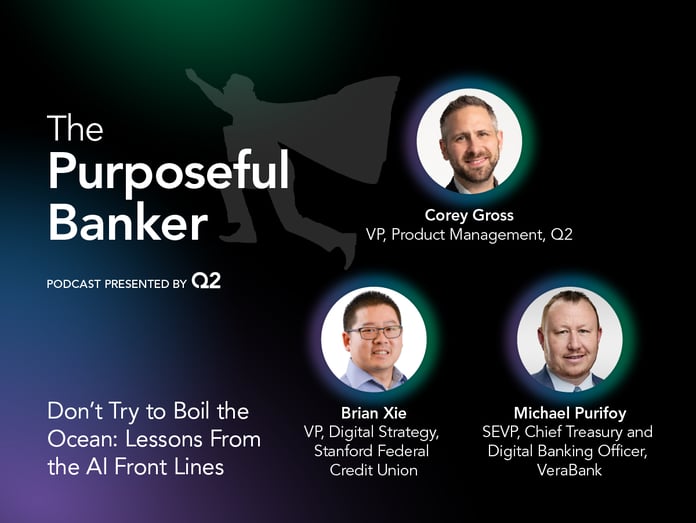
In this episode of The Purposeful Banker, we're sharing a replay of a recent Q2 and Bank Director webinar on AI adoption in banking. Q2's Corey Gross talks with Brian Xie of Stanford Federal Credit Union and Michael Purifoy of VeraBank about moving AI from scattered experiments to enterprise strategy, winning over risk and compliance teams, leading change management, and measuring results that hold up with the board.
Listen
Subscribe


.png?width=255&height=116&name=Spotify_white_bg%20(1).png)
Related Links
[Webinar] Smarter Support, Real Numbers: How FIs Are Getting Measurable Value From AI Agents
Transcript
Cheryl Brown
Hello, and welcome to The Purposeful Banker, the podcast brought to you by Q2, where we discuss the big topics on the minds of today's best bankers. I'm Cheryl Brown. Welcome to the show.
Over the past six months, AI has moved at a breakneck speed from a side experiment to one of the most consequential conversations in banking right now—among financial institution leaders and their boards as well as among employees on the frontlines. Earlier this month, we worked with Bank Director to broadcast a discussion with two FI leaders who shared what they’re doing with AI, how it’s being received, the benefits they’re seeing, and the lessons they’ve learned along the way.
Leading the conversation is Corey Gross, Q2's head of data and AI. He's joined by Brian Xie, VP of digital strategy at Stanford Federal Credit Union, and Michael Purifoy, chief treasury and digital banking officer at VeraBank.
If you're still trying to figure out where to place your bets on AI, or you're deep into rollout and want to know how others have handled the same challenges you’re facing, this conversation has something for you. Let’s tune in.
Corey Gross
Before we get into the meat and potatoes of the conversation, I thought it would be appropriate to really kick off with a bit of a state of the nation in terms of how FIs are experimenting with AI and what the adoption curve looks like because I think it'll set the conversation up well.
I remember a couple years back at our conference CONNECT where I sat with a group of folks around the table at lunch, really post ChatGPT had taken the world by storm. Everyone was experimenting, but everyone was also fearful of what this could mean for their respective businesses and really made the world writ large.
And so while there have been certainly folks that have pushed back against the rapid adoption of AI solutions across the workplace and across the world, I think we're starting to see that early experimentation turn into real-life use cases that can drive businesses forward, whether that comes from cost efficiencies that can be gained by implementing AI in the back office, new revenue expansion opportunities in terms of helping acquire customers in a far more personalized way, but also just the productivity gains that folks can get having a helpful assistant by their side working with them to solve real customer problems.
And so I think it's fair to say that that early skepticism from what were once flashy demos has turned into something resembling conviction that AI is going to be here to stay and it is going to be a true force in enterprise business transformation, in particular financial services transformation.
And so today is a conversation, I believe, with two leaders who really embody that shift from early experimentation to strategic adoption. And so I’m really excited, Brian and Michael, to have this conversation with you. So maybe to start, Brian, Michael, we'd love for you to introduce yourselves, your role and where you are at in your AI adoption journey. So Brian, let's kick off with you.
Brian Xie
Yeah, thanks Corey. I'm the VP of digital strategy for Stanford Credit Union. So being with the role for a little bit over five years now and been with the credit union almost 10 years. Where we are at is really we are at a selective stage at this moment to now selecting the type of AI that we want to implement. And we serve over close to 100,000 members and $4.5 billion in assets for Stanford.
Michael Purifoy
Yeah. Corey, Michael Purifoy, chief treasury and digital banking officer here at VeraBank. VeraBank is a 96-year-old community bank with $4.5 billion in assets and 42 branches across East, Central, and Southeast Texas. And I would say that we started this journey and really started putting focus on it about 18 months ago or so. Really since the beginning of the year, what we've been doing is trying to build that foundation and establishing what we feel like are the core elements needed to scale this appropriately and responsibly.
And so we've invested in a dedicated AI leader, and we are building a team around that person because we don't want to treat this like a side project in IT. We don't feel like that's not going to be a recipe for positive growth there with this technology. We spent a lot of time around governance and developing and trying to align our bank with regulatory expectations, even sharing that governance with the OCC and getting their feedback on it.
And we've spent a lot of time with our leadership team because we felt like that if our leaders were not going to engage with the technology, we couldn't expect the others within the bank to engage either. And so we've looked for opportunities across multiple work streams.
We did the hard, painful work, started this, again, 18 months ago and really at the beginning of the year going through and looking at all of our work streams to see where there are opportunities. And we've deployed an initial set of AI tools that we've developed and put into production, including a GenAI knowledge-based platform that every employee has access to.
And so at this point, where we are in the journey is we're trying to move all of our employees away from experimentation into execution and instead of asking the question, which we've been doing at the beginning of the year, is what can this technology do, we're instead asking the question of which opportunities should we build and scale first?
And so we've got this huge pipeline that exists. When people start seeing what the technology can do, they start thinking of use cases, and we've almost asked them to stop because we have almost 1,200 opportunities identified, which is good. But now what we're having to do is try to figure out where do we prioritize and how do we deliver over the next 12, 18, and 24 months. And so the AI strategy is becoming much more of an enterprise strategy for us.
Corey Gross
So on that thread, it's funny the shift that has taken place not just within VeraBank, but really across the industry over the last 18 months. So I'll pick on that and I'll turn to you, Brian, for the first question. It sounds like the major threat here is we've moved past experimentation and fancy demos and more towards strategic intention, whether that's selective implementation or enterprisewide transformation. So how would you characterize, Brian at Stanford, what that shift has looked like from the inner workings of a financial institution over the last 18 months to get you from experimentation and demos to intentional strategy? What did that look like?
Brian Xie
That's a very good question, Corey. About 18 months ago we were exploring different areas, including fraud, member services, and internal productivities. We weren't looking for AI just for AI. We were trying to understand where it could make meaningful differences. What shifted was we realized that some of the biggest opportunities were actually behind the scenes. So we found that frontline employees, we have spent a lot of time navigating systems and searching for information. That wasn't because they lack expertise, it was because the information lives in so many different places. That's when our focus became more intentional. Instead of exploring broadly, we started targeting use cases where AI could help employees work faster, more consistently and ultimately provide a better experience to our members.
Corey Gross
Yeah. It's a good call out where it's like now we're looking at instead of the one-off bespoke value adds, it's now looking more maybe categorically like where do we find the most pain? If we implement AI, will it eliminate silos of data? Where will it eliminate broken handoffs and where can we actually see movement in terms of productivity? And so you talk about, Michael, the deliberate and more strategic approach to AI that VeraBank's taken in that time. What did it look like internally to move the conversation inside of a financial institution to this thing is coming, this is a tidal wave that's going to hit us if we don't take action to making it the strategic enterprise business transformation priority that it's become at VeraBank?
Michael Purifoy
Yeah. Well, so a couple things happened. I think it became clear to us there was this turning point when we started going through and mapping out our processes, which was if you haven't done that in a while, it's painful. Nobody likes calling their baby ugly. And so we actually had to partner with a third party to actually look at all of our workflows to see where the opportunities lied. It's similar to what Brian was saying. We didn't want to start with the technology first.
And what we discovered was that many of our processes contained much more friction and inefficiency and manual work than we even realized. And so it became an eye-opening moment for our leadership team while we were experimenting with this technology to say we essentially recognized that AI wasn't just another technology trend and that we could use the technology in a practical way to remove the friction, to reduce risk, to help our employees spend more time on high value work.
And so really from that point forward, the conversation shifted from just exploring AI to strategically deploying it where we felt like it would create measurable value.
Corey Gross
Right. It's like the inflection point was around not just the capabilities that the systems or that various models are capable of in demo environments, but how do we apply that to places where we have issues that we can see clear business uplift?
Michael Purifloy
It wasn't just a cool thing anymore. It was like, no, we can really take advantage of this. Correct.
Corey Gross
And so I want to turn the conversation a little bit to something that I know can be looked at as a bit of a roadblock to AI adoption or really the adoption of any new transformational technology. And that's getting internal teams, compliance teams, regulatory teams bought in to executing with AI responsibly. And so, Brian, can you help walk us through what that process looked like to get internal buy-in? So who do we need to bring along internally to get them comfortable with the capabilities that the follow-on benefits of leveraging AI internally for a lot of these back-office use cases that you brought up is worth the effort and the potential risk or certainly the perceived risk of using these tools? So how do you use compliance and risk, your partners in those organizations as partners in crime to help push this forward rather than gatekeepers that block the adoption of new transformational technology?
Brian Xie
Corey, if I'm being honest, this wasn't a one-meeting decision. There was quite a bit of back and forth. We needed alignment across risk, compliance, operations, technology, and executive leadership. Everyone had legitimate questions about what could go wrong and how do we govern the AI and how do we know it was creating value. One thing that worked well for us was involving risk and compliance from the start. We are not showing them a finished solution and asking for approval. We're asking them to help shape the framework. That changed the conversation from should we do this to how do we do this more responsibility? And that was much more productive discussion in my opinion.
Corey Gross
And it's probably also not just a one and done conversation once you get approvals on a couple of AI projects. It's a continuous partnership in terms of a value because the technology landscape is changing sort of weekly now. So it's an evolving conversation with these folks that you're going to partner with over the long haul versus ask for permission, move on to the next thing type of story.
Michael, something you mentioned about getting the internal teams catalyzed to execute this sort of business transformation. I know from my conversations with Brad, CEO, and he's very pro-AI. And so how did you and Brad and others make the case to the board and other senior leaders that, and let's be real here, this is not exactly the kind of industry that has made hay for rapid change. It's an industry that tends to be a little bit more conservative in terms of the pace of change to protect customers and members in what is a highly regulated space.
So how did you, Brad, and the team make the case to senior leaders and the board that this was the direction that VeraBank was going to invest in?
Michael Purifoy
Yeah, I wish I could tell you a story about how we just did a really good job of presenting this to the board and got their buy-in, but I'll be honest with you, we've had to spend more time with our senior leaders than we have had to with the board. The board's actually been pushing us, especially over the last six months or so, and challenging us to say, "Hey, are we moving fast enough? How can I support?" Because they see the opportunity and the disruption that this is going to have within our industry. And they're very supportive, and we have several board members that … One of which works at an AI company in Silicon Valley, so they understand how quickly the technology is evolving. But I think we've been deliberate about framing AI as a business transformation discussion rather than a technology initiative. And the focus is on improving the customer experience.
We tend to want to shift away from that and go to just efficiency and how we can eliminate low-value work. And that's definitely a part of it, but we're trying to shift it back to how can we really utilize this to improve the customer experience, reduce operational friction, strengthen risk management, and put ourself in a position where we're creating capacity for growth. And I think as a community bank, we are consistently emphasizing that AI is going to help us deepen relationships and not replace them, which I think is kind of the fear.
And so for our board, the discussion has been centered around the business outcomes. And we're also talking a lot about governance because we want to make sure that they understand that we're doing this in a way that's responsible and also ensuring that adoption occurs in a way that is responsible as well within the framework that regulators and our board expects as well.
So we found that the conversation starts with outcomes. If you start with outcome and not the technology, the alignment becomes a little bit more natural.
Corey Gross
I want to pull on this thread a little bit more on change management, business transformation, AI not being solely a technology, an issue of technology rollouts, but one of change management. So Brian, how do we unpack the distinction between the adoption and rollout of a new technology and the process of getting the teams to embrace change? Because we know that in practice, these AI capabilities are only going to yield the efficiency and productivity gains if they gain that kind of acceptance and adoption. So how do you frame that difference and maybe share some tips with the audience here? It's like how do you get people to embrace this and use it in ways that doesn't feel like they're putting themselves out of a job since that was so much of the initial fear of embracing AI?
Brian Xie
Yeah, Corey, this is probably the lesson I emphasize the most and I'll share some more examples as we continue the conversation. The technology is important, but the technology isn't usually what determines success. The real challenge is helping people change how they work. So employees need to understand where the tool fits and how to use it effectively and when to trust it. And what we discovered was that once people saw the value firsthand, adoption becomes much easier. The conversations really changed from why should I use this to can I use this in other area too? That's why I always tell people to treat this as a change management exercise, not a technology rollout because that makes huge differences.
Corey Gross
So that kind of feeds perfectly, the change management part of this versus the technology point of it. I want to talk about real-world deployments, something that you are both very familiar with. And not just isolated cases, but more strategic rollouts and more strategic deployments.
And so I'll start with you, Brian, since you brought up the point about back-office support operations as being an important place to start because you could have more measurable business value to be able to AB test against. So let's talk a little bit about the use cases themselves. What are the use cases that you fixated on deploying first and how did it look like to actually deploy this to people that you know have to train how to use a new tool and maybe follow a new process? What was the actual tactical process of getting this deployed with that use case being the framing device here?
Brian Xie
Yeah, so we looked at where employees were spending the most time and effort. So a common theme was that we're constantly moving between systems to find answers for our members. Even experienced employees were spending time searching, validating information, and piecing together a response to our members. We felt AI was a natural fit because it could act as an assistant helping employees to get the answer much faster, not by replacing expertise, but by reducing the time spent looking for information. So our first deployment focused on those support and research workflows where we could clearly measure the impact and keep the risk profile manageable.
Corey Gross
So we talked about—Brian, I'll stay with you for a second—this 17-step process that took a bunch of time to execute and you've been able to use AI because the superpower of AI that people perceived initially, especially in the ChatGPT days, is the human-like interaction. So taking a multistep, multiprompt conversation and making it feel natural, and you could really ask it anything. So it was content generation and summarization with the early sentiment on where AI delivers sort of that wow factor value. But really for folks like us that have tried to apply technology to use cases that drive business value, we saw the superpower as workflow automation. So that's why I bring up this whole 17-step process. Think of 17 failure points, 17 opportunities for a human to mess up a step that might just be a rote task, 17 potential handoffs or 16 potential handoffs to get to the next step to ultimately deliver a practical outcome or an expected outcome.
So you mentioned that you were able to take something that took a lot of steps and a lot of time and shrink it into almost no time. So can you walk the audience through what that looked like before and after and why workflow automation is where the real unlock is when it comes to deploying AI at an institution?
Brian Xie
Yeah, Corey, so one of the example we use is researching when a member changed their password and identifying an associated IP address. So before AI, an employee had to navigate through, gosh, multiple screens and follow about 17 separate step for someone who knew exactly what they were doing. It still took around more than six minutes of time. So today the employees, they can just simply ask a question and get the answer in under 55 seconds. And we looked at the time study on that. But honestly, the bigger story isn't the six minutes versus 55 seconds. The bigger story is really it's the consistency that you mentioned earlier, and Michael and Corey, you too. So new employees can perform closer to experienced employees, and experienced employees honestly can focus on solving member problems instead of searching for the information. And for the member, it means getting the answer much faster and spending less time waiting on the phones or sitting in front of the member advisor in the branch.
And this is where we see the value of the AI.
Corey Gross
So you're not talking just about time efficiencies and time to resolution efficiency, you're talking about raising the floor in terms of what the expectation should be for delivering an optimal member experience.
Michael Purifoy
Corey, can I add onto that?
Corey Gross
Yeah, for sure. Go ahead.
Michael Purifoy
So the other thing too, I think, and I'm going to add on to what Brian was saying, take fraud for an example. We've deployed a tool to help us understand what is happening in the background. A lot of times when we get that phone call from that customer, they're saying, "Hey, something's wrong and I don't know really what it is." And we spend time trying to pull information out of them. And a lot of times half of the information is correct, the other half is probably incorrect.
But if you're able to deploy a tool on the back end, let's say that they're having some sort of fraudulent transactions that are being initiated online since we're talking about with Q2 here. If you're able to have an assistant or an agent essentially prompt it in a way that it's going to bring that information in front of you, it puts us as a bank in a position where we can follow our protocols a lot faster and we can provide a better customer experience to a customer that is having a bad day.
And a lot of times we're not putting ourself in a position where we're trying to spend hours or maybe it's 30 minutes or so trying to figure out what's going on and it involves multiple people. It's one person that can quickly bring that information in front of them and know exactly how to execute for our customer.
Corey Gross
So I think you framed it up really nicely. So I think, Michael, what would be helpful is maybe you're talking about it from the perspective of the member experience being better. How does the frontline staff experience AI? What are some of the anecdotes you've heard before or after in terms of the way a frontline staff member does their job before leveraging an AI solution like the one you're discussing and then after? What are the stories from the field that aren't just reflected in a happy member, but sort of a more empowered banker?
Michael Purifoy
Yeah. So I think just to add on to this particular story or this particular situation that I brought up two things. One, it puts that employee in a position where they're able to answer the customer in a way that's quicker, but they also can have a greater confidence that what they're telling the customer is correct. And so a lot of times there's this hesitation to advise the customer one way or the other because you don't know if you have the right information in front of you to do that. And so you pause because you want to verify and make sure that it's all correct first. Is what the customer is telling me a fact or do I have all the information that I need to truly advise them appropriately?
And what this has done is if you deploy this tool correctly, it solves both of those problems. You're able to provide the answer quicker. You have more confidence. And so when you're eliminating the friction, if you will, the adoption just accelerates very quickly and naturally.
Corey Gross
And so I think for the audience here, what becomes so important then is mapping the workflow like we called out at the top of this conversation. Michael, you talked about the hundreds of candidates of potential workflows that could be transformed to drive business value. That's the real work in all of this, not starting with the technology, but starting in the workflows that create the most pain for staff or the members.
And this may be an open question for both of you, Brian and Michael, what are the signals that you guys look at, or your teams look at, to help prioritize which of those workflows should be the candidates to transform first? Because there's no greater boil-the-ocean technology play than seemingly AI, everything to anyone, but how do you know where to start? Where do you know the value can be realized quickest?
So maybe Brian, if you have one story and then Michael, throw over to you.
Brian Xie
Yeah. So Corey, I think the AI that we picked the first is the one that we can help our employees to do their job more efficiently. And really early on, we weren’t really looking at AI as looking for a story to tell. And we really were looking for something that is able to be measured, and we want data. And having reducing the time is actually a perfect way for us to measure the data on the 17 steps that I kind of mentioned earlier.
So before the deployment, we measured the number of clicks and the number of steps and the amount of time required to complete a specific workflow. Then we measured that same workflow after introducing AI. That gave us a clear before and after comparison. And this is the reason why I like to use a 17-step example is because everybody understands it immediately. Whether you're talking to the frontline team, the senior leadership, or the board, reducing six minutes to under a minute is a really easy story to understand. This is the reason why we pick operation area for the AI is the first choice for us.
Michael Purifoy
So Corey, I think that the way we looked at this after we mapped all of our workflows out and we saw where there was friction and some gaps, we said, what area do we want to look at that we feel like is really going to move the needle and where we are placing focus today?
So I'll give you an example, maybe our commercial workflow. We see that we want to put ourselves in a position where we're able to make decisions faster. We're able to essentially eliminate some repetitive work and we want to reduce friction for both our customers and employees. And so if we're able to do that and speed that workflow up so that we're getting deals across the finish line faster and we're making better and faster decisions, then it should put us in position where we're creating opportunity for ourself because we're delivering a better customer experience compared to our competition.
Corey Gross
I think what you said there really hits home for me because a lot of the way we even prioritize building agents or AI solutions is where's the multistep process that we know creates the most friction for the operator or the user, whether they be an account holder or a banker. And then how frequently does that process get executed? So it's like high value because it's so difficult to execute this workflow end to end because there's 17 steps, in the case of Brian's, and it happens a whole lot. So it isn't an edge case that you're trying to use a stick of dynamite to swat a fly. You're not applying a really expensive, really hefty solution on something that doesn't happen very frequently. You're actually taking something that happens all the time and you're really creating that ROI because you're reducing a lot of friction for a lot of different people.
And so I think that sets up the measuring success bit. And Brian, you already kind of framed this as the AB test of before and after, 17 steps to very few, 10 minutes of work to almost none. But what's the right framework for defining success before go live in addition to some of the metrics that we're already calling out here that matter most? How do we know what the baseline for success is, even though the application of AI can be implemented differently use case by use case to let you know that, yeah, we did the right thing, we're winning. Or hey, let's pull the ripcord. This is a good experiment, but it's not going to net the long-term results that we hoped it would for the cost of implementation.
So what are some of the measures that you use? And maybe Brian, we'll start with you.
Brian Xie
Yeah. So Corey, I mean the success that we're really looking at this area is our time to handle the call resolutions because the duration of the call, you're going to be ... In the past, we looked at the baseline of talking to this 17-step call. Usually takes about six minutes-plus call to handle our members' questions or situations. And after introducing AI, we're able to see the call reduced down dramatically, not six minutes, not seven minutes, not eight minutes. It's actually moving into an average of about 2 to 3 minutes per call. And you see almost a huge amount of time to drop. What that means is our agents on the contact center are able to serve more members instead of them waiting on the phone line and listening to that beautiful music and putting them to sleep. And this is one of the things that we are really looking at.
And the second thing is we’re also measuring by the NPS, the net promoter score. And we've seen those scores being jumped in the particular area of the contact center. And we can see that has been improving. We only had the AI for the last few months, but we've really seen the value, and it's been going up to the 80s where we've been seeing in the past about 60 to 70. So it is a tremendous improvement on what we see on having the AI deployments.
Corey Gross
Michael, how do you translate some of the more tactical gains and metrics like time to resolution, CSAT into board worthy or senior management worthy conversation? Because I'm sure we don't want to get as granular in terms of project by project where AI is making an impact. How do you roll that up into this investment was worthwhile and here's proof?
Michael Purifoy
Yeah. So what we're doing is we're connecting the outcomes back to our organizational objectives. So we have four strategic pillars that we're focused on: prudent growth and profitability, improving operational efficiency, enhancing the customer experience, and then leading and supporting our employees in an appropriate way. So rather than discussing, to your point, the models and prompts and the details, the technical performance, we're focusing on the business value. And we do talk about reduced cycle times and improved consistency. We want to be able to show that, but we also want to make sure that we're showing, hey, we have built in capacity for our production staff to be able to go out and spend more time building relationships so that we are going to grow prudently.
We know for sure because of metrics as well as feedback that we're getting from our customers that the customer experience is better. We're measuring risk in a way that's much stronger. So I think while we are talking to the board about the way we're rolling this out and we're doing it in a responsible way, we also want to make sure that they know that the investment that we are making here in people and in technology is advancing the strategy and is creating value within each one of those four pillars and that we're deploying it in a way that is responsible.
Corey Gross
And maybe pulling on that board reporting piece and the responsibility to produce defensible and accurate results to a governing body like a board, what infrastructure should be in place to get them confident about board reporting as it relates to AI solutions? Because it is so different than your typical run-of-the-mill software solution stack. Maybe an open question for both, but anyone who wants to pick that up?
Michael Purifoy
Yeah, I'll take it. So I think that we've been intentional from the beginning about building that strong governance plan, but we also, we've got to tell our board it is going to evolve as the technology evolves, which is happening very quickly. But we treat it like it's not just one single policy because I think you can build a policy then set it to the side and then just run and it's wild, wild west. We don't want to do that. But we want to create this operating discipline where we are clearly defining what AI can recommend, what it can prepare, what it can execute. We're explaining those things to our leaders and to the people that are using the tools and then as well to the board. And that also we are maintaining human oversight at points where there can be significant risks either to the customer relationship, to regulators, or a business impact, if you will.
And so we want to be able to show that we can explain what the technology is doing, that we have audit in place to make sure that whatever we put in production can be explained. And we are not involving— which there's this itch to do this—is that you're involving compliance and risk teams late in the process and they're kind of that final checkpoint. We're not doing that. We're involving them early so that they understand what we're even trying to develop and build or what we're evaluating to put into production. And we've seen that if we do that, it actually doesn't slow innovation. It puts us on a good pace. It speeds us up so that we don't spend a lot of time doing something and then we get to the very end and we stop it because compliance or somebody from our risk team says, no, we should not be doing that. It's not time yet. So I think if you do that the right way, it should create, and what we've seen is it does, it creates a confidence that I think is necessary to innovate responsibly, but also scale at the same time.
Corey Gross
Awesome. Brian, anything for you to add?
Brian Xie
I'm going to echo Michael's point, really engage risk and compliance already. Don't give them that here's a solution and approve it. Work with them from the beginning and they will be your best partner and will help shape the framework of AI.
Corey Gross
And maybe as we turn to the last section, Brian, I'll stay with you here, which is a lot of lessons learned along the way. I know the three of us have worked together on a project, and there's a lot of things that we were blazing new trails together. So we're seeing all the mistakes we wouldn't have made had we known all these different bear traps that come at us when you roll something like an agentic solution into production. But kind of rewinding to the start of the journey that you took Stanford on and Stanford has been on in terms of the adoption of AI, what would you do differently if you could start over? And what are some of the lessons that you learned the hard way that you wish you knew to make sure that you didn't have to go through the pain that can follow implementing AI in maybe less than ideal ways?
Brian Xie
So if I had to start from the beginning again, I'd probably spend even more time on the people side of the equation because people get nervous when they think about AI, and the first thing they think about is, oh my God, my job is going to get replaced. We need to understand them because looking back, the technologies move a lot faster than the organization readiness. People hear about the news of OpenAI and all other AI tools, which I think is normal, but it's something that I appreciate much more today.
I do still start small. I do still involve risk and compliance already like I mentioned a couple times, and I do still focus on a use case that's easy to measure and easy to explain. But I do invest even more effort in communications, education, and helping employees understand why we are doing it because the employees understand the why is very important because if they don't understand the why, you're not going to get the adoption and you only can give them more fears.
The biggest lesson I pretty much pretty simple to me is don't try to boil the ocean. Solve one meaningful problem, prove the value, and learn from it and then build from there.
Corey Gross
Agree. I echo that sentiment. And maybe, Michael, you got a lot of folks on the line that are evaluating various probably AI products, places to apply AI within their institution. What's one thing that you would say that if they're not doing today with AI, they've got to do within the next 90 days? What would you put at the top of their priority list if they're just getting started?
Michael Purifoy
It is painful going through this process. It's really where the real work starts, but you have to understand your current workflows. And if they live in people's heads and you're trying to build technology on top of that without spending the time to understand where there are gaps, then I think you're probably not going to go down the right road. And so you've got to identify where employees are spending time gathering information, where the customer experience is seeing friction, and where risk hides. And so I would definitely start there.
And then two, I think one thing, just to Brian's point, we mapped all of our processes across 10 different areas, 10 different departments in the bank. And our thought process was, OK, after we get that done, then we can just start working on all areas throughout the bank and move down this journey focusing on all 10. We figured out real quick that that was not a good idea. And so we've chosen to really focus on one or two, what we feel like are high-value workflows, and then also make sure that you establish your governance so that you're scaling appropriately and building trust with the board and then with your employees along the way.
Corey Gross
Yeah, thank you. Maybe we'll close with this, though, which is a lot is happening seemingly every day in the world of AI: product announcements, capabilities that are being released, different benchmarks being hit. But in financial services, what has each of you most excited about the transformational potential of the technology? Not necessarily from a product perspective or a specific workflow perspective, but what this will mean in terms of enterprise transformation at the institution level and ultimately downstream for the communities that you're serving. So Brian, maybe we'll start with you.
Brian Xie
Yeah. So Corey, I think one thing that I would say is that the technology got us interested. The operation result got us excited, but the employee adoption is what makes it successful. And that's why I view AI as a change management exercise first and a technology initiative second. And what this means to our community is really to serve our members in the credit union space is that more efficiently and also allowed them to do self-service too. Today we're deploying back office, too, but tomorrow we can use the AI more effectively and then reduce the calls to the contact center so our employees can become more engaged with our members versus just talking to them, solving the problem for them. And that's where I see we are heading, and engagement is an important aspect to the organization at SFCU.
Michael Purifoy
Yeah, I think what excites me the most is the opportunity to make VeraBank better and put us in a position where the things that we do well, it just takes us to the next level. That we're able to make banking more personal, not less personal. Community banking has always been built around trusted relationships and sound judgment. And I think AI gives us the opportunity to scale our expertise, improve our ability to respond to our customers’ needs, obviously monitor risks more appropriately and proactively, and reduce routine work for our employees every day.
And so I say this all the time to our team when I get in front of our bankers, too, my hope is that AI quietly handles the behind-the-scenes work so that our bankers can spend more time delivering the advice and service and guidance and build relationships that our customers I believe truly value when they choose to bank with us as a community bank. So I think this is where community banks and banks in general can, if they do it the right way, AI can become a competitive advantage for them.
Cheryl Brown
And that’s it for another episode of The Purposeful Banker. If you’re interested in more discussions about the real applications, challenges, and lessons around applying AI to the banking industry, check out our sister podcast, Cut to Context, hosted by Q2 CTO Adam Blue. You can find it in all the same places you find The Purposeful Banker, including YouTube, Apple, and Spotify, and you can find both podcasts at q2.com/podcasts. Thanks for listening.