27 Feb, 2026
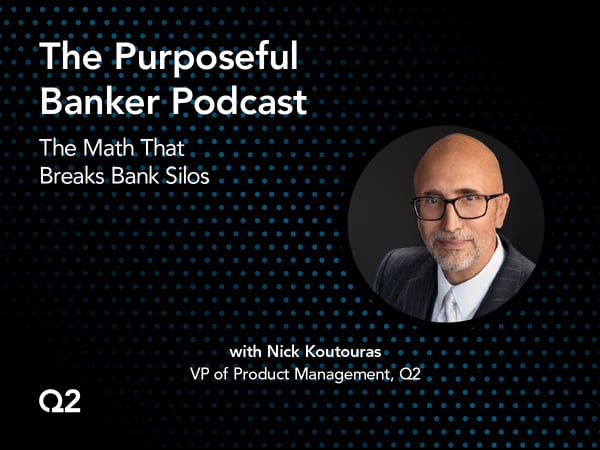
Nick Koutouras, leader of Q2’s Relationship Pricing and Profitability team, explains why bank silos persist even with aligned teams: because the “shared math” arrives too late. Learn how relationship-level economics, the four seasons of banking, and delivery-to-promise reviews help leaders prevent drift and make better decisions.
Listen
Subscribe



Related Link
[Podcast] Take the Emotion Out of Relationship Management
Transcript
Cheryl Brown
Welcome to The Purposeful Banker, the podcast brought to you by Q2, where we discuss the big topics on the minds of today's best bankers. I'm Cheryl Brown. Welcome to the show.
If you've ever looked at your bank and wondered, “Why do we still feel so siloed even when everyone here is smart, well-intentioned, and trying to do the right thing,” well, today's episode is for you.
Today, I am welcoming Nick Koutouras back to the show. He's the leader of Q2's Relationship Pricing and Profitability team, which includes Q2 PrecisionLender, and Nick has written a playbook he calls “Beyond Pricing,” which digs into the idea of how to drive real profitability from commercial relationships.
You may remember that Nick joined me in September to talk about how to take the emotion out of relationship management, and today he's going to share a useful way he has of talking about the silo problem. That is that silos often survive not because people won't collaborate, but because the economics show up too late. Lending, Treasury, Risk, and Finance can all be right in their own disciplines and still end up making decisions that don't add up at the relationship level. Nick will talk about why that is and what we can do about it.
Welcome back, Nick. Let's get into it.
Nick Koutouras
Cheryl, thank you for having me back.
Cheryl Brown
You say that silos don't form because people won't work together, but rather it's an issue of incomplete information. Tell us more about that.
Nick Koutouras
What ends up happening is everyone's well-intentioned, but you tend to see the numbers measured in their own framework, in their own discipline. All those are built for purpose for that discipline. However, when you look across the institution, you really don't see that all coming together. And for me, it became very apparent (in the) early days. When I received a new assignment, I was asked to take over a CFO spot for a commercial bank, and where the bankers thought we were doing great, where corporate thought we're not doing so well, where credit risk was saying, "There are some spots here that just aren't adding up." When we kind of looked at all those parts and pieces, we had this inconsistency that began forming.
And then from there, we started losing trust. I needed to break that down. And for me, the common way to do that was really looking at the metrics and looking at the measures and creating the trust in those measures that then could reach across the different organizations and start bringing it all together.
Cheryl Brown
I assume that each of those functions, they have their own legitimate disciplines. It's just that they're not reconciled. It sounds like there may be a sequencing problem where the handoff of information is not happening.
What's in that minimum shared math view that has to be present before a bank commits so that Treasury, Risk, Lending, and Finance, they're not debating parallel realities later?
Nick Koutouras
The way I look at it is the first action was just simplicity. Simplicity in the calculation but then consistency. Getting everyone aligned with what we were trying to do.
The root cause was not only that all these different groups had their own way of measuring, but we had complexity in how we were measuring it. Because really what you're doing is each relationship is a deployment of RWA and then a return of all the services that the institution offers. If that trade-off is acceptable, then you can then proceed. But what was happening is that you were looking at that trade-off at different times. While the Line of Business was making the decision to renew that line of credit, to increase that line of credit or new lending facility, Credit may have been making the decision that the credit risk was acceptable.
But months later, we may learn that we needed that liquidity. We had to change our pricing on FTP. We had to change our management reporting philosophy. Then way after the fact, after the capital was out the door, now we're coming back and trying to have conversations about what happened three months prior. That alignment wasn't happening because there was no view that was consistent. What I did is I created that consistent view.
Cheryl Brown
In each of those handoffs, I'm sure, each of those handoffs of information, each one is important, but is there one that's the most dangerous handoff?
Nick Koutouras
Well, I think that's a tricky and loaded question. I think that they're all very, very vital. But I would say I would go back to the premise that capital is the bedrock, but liquidity is the lifeblood of the institution. It's a bit cliche, but that liquidity conversation then tends to dominate, and that's the one that can get very dangerous.
I'll give you an example is that we had a very large client that had a large deposit platform, plenty of treasury services, as well as a deployment of loans and whether they're revolvers or term loans. It was just a full relationship. And we had a few of those. However, in their own silo, my Corporate Treasury partners started running reports on liquidity and assessing where we had excess liquidity and where we were paying for that excess liquidity. The instruction came back, looking at it in a vacuum, that says the problem was we have too much liquidity. We're trying to manage NIM. We've got to trim the liquidity. And they use this phrase that that still jars me a bit. You must debank these clients.
They made that decision in this vacuum without really understanding the full relationship and the implications by debanking. These clients were not a faucet. We couldn't turn it off and on. And again, another cliche, but you couldn't shed that liquidity without compromising the full relationship. I had to do a lot of work to bring that to them, and then the decision was a little bit easier, and they were able to look at other pockets where there was excess liquidity, and I was able to defend the decisions on those relationships because they were outside of the conversation.
That could have been catastrophic for the institution because these were large, strategic relationships. And if we had to execute on that instruction, it would've been bad news for us.
Cheryl Brown
That's a great example of a silo really, really being not a great thing. You've told us why we have the silos. Simplicity was the answer. The simplicity of the math was the answer.
Can you tell us a little bit more about exactly what that means? You've mentioned to me before that you've made the relationship be the unit of value. What does that entail?
Nick Koutouras
If you think about classic management reporting financials, there's nothing profound there. You have a balance sheet that's loans and deposits. You have an associated capital charge, then you have revenue that comes in the form of loan revenue, deposit revenue. You have your fees, and then you have your expenses, and it just kind of cascades all the way down. And then you have a calculation that ultimately leads to an ROE.
We got everyone speaking the same language. I got the Line of Business comfortable with that because that was what Corporate was using to measure us. I'm using Corporate in those air quotes. But the top of the house had an expectation, and that was how budgets and how forecasts and how year-over-year growth was measured. We were able to get that mind share with the Line of Business.
But then what I did is I took those financials. And if you think about it, visualize in your mind's eye all the relationships that add back up to those financials. What I did is I went and retrieved all those financials for all those relationships. Measuring that ROE is really the forcing factor. Really, the constraining factor was capital for us at that time in that cycle or the season, and we'll talk maybe about that later. But in that season, capital was the constraining form. But by having all those relationships that add back up to my financials, I created that depth. And then that's what started breaking down the silo. But really, we've said that a few times. It improved the awareness of not only what we were doing in the moment but what the implications were in the financials.
If you do a one step further, when I looked at my pricing and my relationship measurement mechanism, I made sure that those ROEs there were aligned back to my management reporting and back to those relationships.
Cheryl Brown
What were the leaders' response? Was it a “Eureka!” kind of moment, or were they surprised? Or was it just like, "OK, yes, now we're talking?"
Nick Koutouras
Yes. A big and/or question with a yes. There was a little bit of eureka. There was absolutely, though, a desire to really know what was good and what was not. And by doing this, the light bulbs went on. But by doing this, there was more comfort in the financials.
In the early days, my philosophy was the way to get that mind share was to give them the details and then step them through the details because it's intimidating. Sometimes the bankers just don't want to see a wall of numbers. This giant spreadsheet of numbers. But when you walked them through them, and you showed them all the transparency, you handled all the, "Yeah, buts”—"Yeah, but you're missing this," or, "Yeah, but"—I got them comfortable that everything was there. Then I can then pull it back and start summarizing it. But once I was able to do that, I was able then to get them comfortable that those decisions they were making on yes and no on the opportunities were accretive or dilutive to the financial plan. That was their aha moment.
From, if you will, the top of the house or some of our partners that are around our unit, they embraced what we had because they started seeing that we were running this unit with discipline. They were able to see that we had a consistent framework and that our deployments of RWA and our next loan opportunity and those relationships that we were managing, we had a prudent approach. We had rationale when we had to sacrifice a little bit of pricing to get some of the ancillary business. For them, their aha was an acceptance of a method that was now being deployed. It wasn't theoretical. It was practical.
I guess the final answer to the question was, because we had this closed system, I was then able to secure more capital for our group because we wanted to grow even in specialty areas and other spots. I was able to go make that case because, again, we had a prudent mechanism to deploy the RWA.
Cheryl Brown
And I'm sure it helped the buy-in more because each of those teams could see their own metrics reflected in the overall method, right? It's like everyone's represented here.
Nick Koutouras
We got to the point, the maturity of our system, we were able to simply see the next transaction, whether that was going to be accretive or dilutive to the financial plan. It was that simple. And then the conversation stopped being about numbers, and that's maybe the plot line in the background. We stopped talking about numbers. That's really what you want to do. You want to stop talking about numbers, start collaborating, and then start finding all the parts of the bank that, perhaps, maybe, what may be missing.
When you have questions like, "What are we missing? What are others doing? Do we like this credit? Do we want to go bigger with this credit and get more share of the wallet?" those are the conversations that started happening. We got out of the numbers business because the numbers were the base of the conversation, but we just said, "There's the number. It's accretive. It's dilutive. What can we do to bring it back into a more acceptable return?"
We rarely then talked about the numbers. It was just a thing on the page, but you got into the business of understanding this difficult relationship. Difficult in that it may have been priced—we used to call it the pricing snug, or we would say, "We're not getting enough goodies," because you want to get all the cross-sell. That jargon and those code words were really designed to say, "What else can we be doing here?"
I think the other bit, too, is that we were able to identify where we had gaps, where there was a competitor in with a wedge product. And that's why it made sense for the competitor and not for us, but it was instructive. Those are the hallmarks of the system after we kind of stabilize the numbers, established that as the primary metric, and then people could then have the conversation.
Cheryl Brown
You mentioned a minute ago about a season, and in your playbook you say that the bank has four seasons. Walk us through what those seasons are.
Nick Koutouras
Four seasons is something that I coined, and it was one of these awareness items where I was cleaning out an office. I was moving to another office, and I came across an old strategy document. And it talked about improving returns, deepening relationships, NIM management, and then finding liquidity in treasury management. And this was 10, 15 years old. It dawned on me that we go through these seasons, and it's not seasons … like they're not sequential, and these are not the only priorities of a commercial bank, but when you're in the moment pricing a transaction, these tend to be the four areas that dominate. And I'll speak to each one is capital focus, liquidity management, NIM improvement, and then deeper relationships revealed in the form of ancillary or non-interest income.
Those tend to always circulate as priorities depending on what's occurring in the market. When you have times where there's capital constrained, or there could be crisis in the market in a macro factor, you may see banks tightening their deployment of capital and really become selective. If you have periods of time where you have excess liquidity in the market or limited liquidity, something's happening in your institution, you just did an acquisition, and you need liquidity, you need to hold on to liquidity, then you can make some choices there. You have NIM that you're trying to manage. Sometimes when you're priced below market, you're trying to improve it. And then obviously the fees. But you want to get deeper. You want to bring more non-interest income to the revenue.
But what I've found over time is that you drift through those different priorities. But, if you built a mechanism that, again, has standardized measures, you've broken down your silo, what you then have to manage the seasons is just mostly just a reconfiguration or adjustment of targets or perhaps an adjustment of what becomes more of a difficult relationship you want to have a group talk about. And that's how we were able to navigate through all the seasons.
If you go back to 2025, like I did, and I synthesized all the earnings reports from all the institutions, depending on the quarter, they had a different season that was emerging, whether it was liquidity and the price they're paying for deposits in the second quarter of last year to sort of an opening up of the balance sheet and getting ready to lend more in the third quarter, but really lend more with an eye on treasury services, and then fourth quarter was really about a bullish view on lending but, again, coming with the treasury products and focus on that.
But the point being the four seasons are always going to be there. And what you do is you build a mechanism that's adaptable that can behave to ... It's like going outside when it's cold. You wear a jacket, and sometimes you don't need it because it's summer. It's exactly the same thing. You make minor adjustments to your mechanism of what's underperforming for the season, and then you as a team look at it and then come back around and manage that relationship.
Cheryl Brown
Is that the best way to anticipate or look at what season a bank is in, is just to go look at their financial reports? Or are there other ways to kind of anticipate when they may be entering a liquidity season before funding pressure forces everyone's hand?
Nick Koutouras
I don't know if I'd look at it that way. The way I see it is the institution knows what season they're in. Internally, was they're meeting, and they're gathering, reviewing quarterly reports. They're doing their MBRs, monthly business reviews. Quarterly business reviews. Their internal cadence. They'll know the season.
For me, that season and those executives, those key stakeholders, will then ... Once they identify the season, they can then easily set the criteria that would suggest here's the season we're in. And I could be in a season of ROE focus. I want to manage my ROE. My performance hasn't been where we thought we were going to be. What you could do is you change your hurdles, you create a higher hurdle, and then what that does is it flags relationships that perhaps need to have some attention.
But those stakeholders will define what is underperforming in the season. They will then issue instructions to their banking teams to go and begin the process of assessing the full product that the bank has and other ways to manage that season. But the bank knows. Outside in, it's usually a trailing indicator. The institution knows.
Cheryl Brown
Last time I had you on the podcast, we previewed quarterly summaries, and we talked a little bit about delivery to promise. And I just wanted to circle back to that because I think we kind of didn't get a chance to fully talk about delivery to promise.
Just to follow up with that, what should a delivery to promise readout include to surface drift early and prevent the slow creep of exceptions?
Nick Koutouras
Delivery promise is really ... It's a powerful tool. And it's probably inconsistently applied throughout the organization. And to me, I look at that as really an indicator of where there could be training. Training opportunities. Not everyone can speak about swaps or FX or other kinds of banking products. Or it could indicate operational bottlenecks. And the way that comes out is it reveals itself on the report we call promise delivery. This is where a binding term sheet was issued to a client after a decision was made on what the full relationship looks like. Those commitments on the full relationship then essentially go on the board.
Then the institution trusts the bankers' going to do what they can. That's the approach in all of this is everyone's well-intentioned, and we're going to go out, and we're going to promote our products to the client. We're going to bring the best solutions available. And then sometimes we satisfy those. And then sometimes there's a reason something's happened, whether a market force has changed, or there's something else that's going on inside the institution that's a blocker, whether it's operational knowledge or maybe training. We find that some officers are too optimistic in crafting their account plans.
But that is a really important piece that comes back and helps confirm that the decisions that were made prior were appropriate. And when they weren't, that gives you an opportunity to course correct. And also well ahead of that assessment of the season that we're in and what the stakeholder would suggest is we've got to make a change. To me, that's a really important step. I've seen it used mostly with commitments made during that pricing moment where the client was going to bring us some new deposits. Making sure that those deposits did arrive as expected.
And then the other way I've seen it used very effectively is the pursuit of one-time transactions or syndications. Derivatives. Debt capital markets. Those tend to be more complicated and require a lot of executive oversight to make sure that those things, those transactions, actually materialize as expected.
Cheryl Brown
Great. Nick, again, thanks for joining me again, and thanks for giving us a clearer way to talk about decisions that stick and how to make a stronger relationship.
Nick Koutouras
Cheryl, thank you. As you can maybe sense, I have great passion for this. I enjoyed our time together and look forward to seeing you, seeing most of you, at CONNECT later this year in June.
Cheryl Brown
Absolutely.
Nick Koutouras
Thank you again.
Cheryl Brown
Well, and listeners, if you found this episode valuable, share it with a teammate in your Lending, Treasury, Risk, or Finance department, someone who lives on the other side of the math from you, and check out more insights from Nick on his LinkedIn profile as well as on the Q2 blog. I'll put both links in the show notes.
And Nick, we're going to have you back soon to talk more about your Beyond Pricing playbook because there's a lot more goodness in that thing that we want to talk about.
Nick Koutouras
Can't wait.
Cheryl Brown
And that's it for another episode of The Purposeful Banker. You can subscribe to the show wherever you listen to podcasts, including YouTube, Apple, and Spotify. And you can see our archive of podcasts at hub.q2.com/podcasts. Until next time, this is Cheryl Brown, and you've been listening to The Purposeful Banker.