24 Mar, 2026
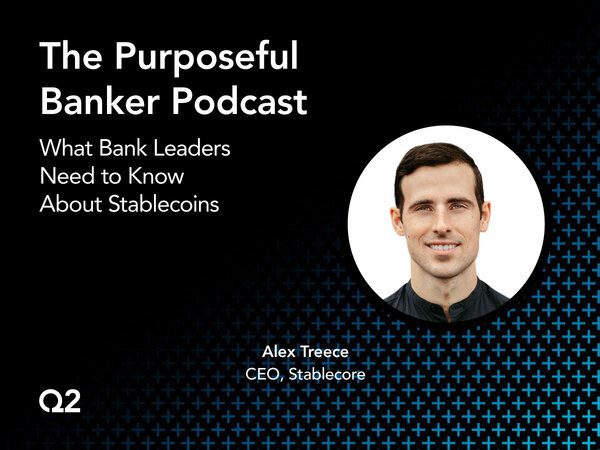
As stablecoins move from industry debate to practical planning, Alex Treece of Stablecore joins the podcast to explore what banks should be doing now to prepare responsibly and what strategic, operational, and compliance questions matter most as digital assets evolve as a payment rail.
Listen
Subscribe



Related Links
[Blog] The Value of Digital Assets in Commercial Banking
Transcript
Cheryl Brown
Hello and welcome to The Purposeful Banker, the podcast brought to you by Q2, where we discuss the big topics on the minds of today's best bankers. I'm Cheryl Brown. Welcome to the show.
Today we're continuing a discussion we started a couple of episodes ago about stablecoins and their application in commercial banking. I've invited Alex Treece, co-founder and CEO of Stablecore, to be with me in the studio today to talk about what bank leaders should be paying attention to right now as stablecoins move closer to real world financial services use cases.
We couldn't find a better person to talk about this. Alex has spent years working at the intersection of digital assets, infrastructure, and financial services, and he brings a practical perspective on how financial institutions can think about stablecoins as part of a broader shift in payments and money movement. Before founding Stablecore, he previously led digital asset ledgering, orchestration, and developer teams at Coinbase. Before that, he co-founded Zabo, a digital asset account aggregation platform that was acquired by Coinbase. So Alex, welcome to the show.
Alex Treece
Thanks for having me. Excited to be here.
Cheryl Brown
So before we get started, tell me a little bit about Stablecore. How did it come to be and what's your mission?
Alex Treece
Yeah. So as you mentioned, maybe some quick personal background. So before this, I was over at Coinbase and helped lead a handful of teams over there. One that I like to talk about is a team called FinHub that did all the orchestration, all the ledgering, all the compliance inside the company. So you can think of it almost like something like a banking core plus something like Verafin sort of merged together. I mention that because that was really a time where we were exposed to just all this infrastructure coming together. On one side, all the custody and wall infrastructure from digital assets, and on the other side, all the banking and payment rails. Overall, both myself and our team have been in this space for the last five to 10 years. I've seen some of that large scale digital asset infrastructure come together.
Maybe just to take, as we get into Stablecore, maybe it's helpful to talk a little bit about the context of the market, which is if you go back to 2023, 2024, when I was at Coinbase actually, it was a difficult time for banks to be in this space, particularly after FTX, and Signature, and Silvergate. There was a lot of regulatory things that were put in place that basically prevented banks from being in the space.
Then if you fast-forward to 2025, all those things change. You had these big regulatory updates, things like all the banking regulators like the OCC and the FDAC and the FRB, all updating their policies. You had things like the GENIUS Act, which was signed into law in July. These effectively made digital assets permissible for banks for the very first time. So it sort of solved that big regulatory problem.
But the other problem that they have is that there's this entire banking technology stack that exists. That includes things like Q2 on the digital banking side and many other digital banking platforms. It includes all the banking cores, it includes all the banking compliance providers. While there's a lot of great companies there, those tools today don't support digital assets. So if you're a bank that's wanting to build in this space, you've got a big gap on that existing banking technology stack that you use.
Then on the other side, the other problem they have is there's all this digital asset infrastructure. That's folks like Coinbase, like where I used to work. It's also the stablecoin issuers that have sprung up. It's all these digital asset compliance tools. There also, there's a lot of great companies, a lot of great products, but those services are certainly not set up for banking. It just turns out that it takes a lot more than just API keys into someone like a Coinbase or Fireblocks to actually run a digital asset product inside of a bank. There's just so many other things that have to happen.
So like integration into your digital banking, integration to your core, integration into your compliance platform, all the orchestration, all the ledgering, all the reporting. So there's just a number of these things.
So what we have here is this big gap between these two sides. Again, on one side, all that banking infrastructure, on the other side, all that digital asset infrastructure. That's really where Stablecore sits. That's really the problem that we solve. So a lot of our clients think of us as being like this digital asset core. I think that's really the right way to look at it. But what that really means in practice is that we're actually bringing these two sides together.
Again, on one side, connecting to all the digital asset infrastructure, all the custodians, all the stablecoin issuers, all the digital asset compliance tools, and actually integrating that directly into the existing bank technologies stack and really meeting banks and credit unions where they are and saying, "Hey, you shouldn't have to just tear out all your existing infrastructure, but let's find a way to actually support these assets from your existing infrastructure, from your existing digital banking, for example, within Q2."
So that's what we focus on. Then the other thing about our company is that we focus exclusively on banking. So we sell just to banks and credit unions. Don't sell to fintechs, don't sell to crypto companies, don't work with any payments companies. Work exclusively with banks and credit unions. So that's just something special about our focus.
Cheryl Brown
So you talked a little bit about some of the market triggers that have changed why digital assets have become more of a conversation now. Does the urgency look different for community financial institutions than for large regional banks? This is kind of something that Todd and I talked about in that previous episode.
Alex Treece
Yeah, I think it's both, honestly. I mean, as I look at our own client base, we see both institutions on the larger side, for example, super-regional clients that are top 25 banks. But we also see banks and credit unions that are more community institutions, between $1 billion to $10 billion of assets, for example, which some people may not think would be as interested in digital assets.
But I think all of these banks and all these credit unions, whether they're big or whether they're small, are seeing a lot of the same trends that are happening. Those trends are things like the GENIUS Act passing and stablecoins growing a huge amount. Things like seeing their deposit outflows to places like fintechs and crypto companies. Even with smaller banks, they're seeing that.
Again, this was a space that before was tough for banks to be in, but with all the regulation changes, these are now permissible activities for banks of any size. So at least in our own client base, we're seeing it on both the large end of the market and on the smaller end.
Cheryl Brown
What about the end customers, the businesses that are banking, whether it's a large institution or a smaller one, what are you guys seeing as their reasons for getting into using stablecoins?
Alex Treece
Yeah. Well, so I would say we should split it by retail versus commercial. What I'll say, if we're kind of narrowing in on stablecoins specifically, it tends, at least in our client base, it tends to be more commercially focused than retail. If I had to put a percentage on, I'd say maybe 70+% commercial versus maybe 30% or so retail. So within that commercial bucket, folks, banks are starting to have clients reach out about these assets.
I think we're going to talk a little bit more about use cases, but just to give people a sense, I mean, some of the use cases within stablecoins we're seeing are things like cross-border payments, and these again tend to be on the corporate side. So we see a lot of activity on that sort of B2B cross-border payments, really almost as like an alternative to international wires effectively. So that's probably one of the top use cases we see on the corporate side.
Another one we see is around treasury management as well. So this is embedding stablecoins into existing treasury management flows. This could be for sending cross-border payments, B2B payments. It can also be for cash management for, for example, these entities that have, or these corporates that have different entities, they might have multinational entities and they're wanting to move those funds around 24/7 very easily. So that's one that we're seeing a lot of.
We're also seeing a lot in the instant payout space. So things like merchant services, making payouts to merchants, things like gig economy workers and these various freelance platforms, areas where you have workers working basically seven days a week and they also want to be paid seven days a week. You're seeing stablecoins be used in a lot of those use cases. You're starting to see clients, those commercial clients that are in those verticals, start to request those things from their banking partners.
The other thing I want to mention, though, is beyond those sorts of more offensive use cases that I just mentioned, there's a lot of banks that we're working with that are seeing just the growth in the stablecoin market and just looking at stablecoin acceptance itself. So today there's around 300 billion or so of stablecoins in circulation. By the way, five years ago, that was around 10 billion. So it's sort of grown from 10 billion to supply to 300 billion in the past five years. So that's, what, something like a 30X in that time period. So there's a lot of banks that are seeing that and saying, "Wait a minute, we just had the GENIUS Act pass and all projections are that it's going to grow somewhere between 3 to 4 trillion from here." So that's another 10X from 300 billion.
They're not wanting to wait around for that transition. They're wanting to put the rails in place so that at a minimum, once you have, call it 3 to 4 trillion of stablecoins circulating in the financial system, there's a way to bring those assets back into the bank. So again, that's not like some offensive use case like cross-border payments, but it's just being ready for this transition and having the rails in place so that when your clients come across these assets, there's a way to bring them back into the bank.
Cheryl Brown
Yeah. I think conversations around digital assets, a lot of times people just go straight to the conversation around speed and use cases. I'm guilty of it. I just put us into that conversation myself. But why don't we step back a little bit and talk about, you've worked with a lot of financial institutions to help them deliver this capability. What are the biggest mistakes that you see financial institutions make when they're approaching stablecoins too narrowly as a payments feature rather than as a broader operating model decision?
Alex Treece
Yeah, it's a really good question. I'd say the mistake we see is not so much that folks are making a mistake in how they're viewing stablecoins within payments. It's sort of missing the broader trend that's at play. The way I described it is that every once in a while, you have these big technology shifts that happen, right? So in banking, it was going from branches to online and then later from online to mobile. Arguably, we're in another one of those big technology transitions with AI. Each one of these is a big platform shift. The way that you lose in one of these platform shifts is that you don't recognize it and you don't shift with it. You don't know.
For example, if you were a bank that just had branches, but you never got into online banking, that was potentially painful. Then later, if you didn't see the transition that was happening to mobile and you never adapted to that, that also could have been very painful and you could have lost customers and deposits and so forth.
What I'll say is that, whether it's stablecoins, whether it's bitcoin, whether it's tokenized deposits, there's this broader digital asset and blockchain technology platform shift that's happening, and that's how you should view it. So it's important to kind of not miss that.
Obviously as a bank, you want to have some initial use case, some initial wedge that you want to focus on. But I think the key insight here is that this is a platform shift and this infrastructure that you put in place, again, whether it's for stablecoins, whether it's for tokenized deposits, even if it's something like bitcoin, it's all the same infrastructure. It's the same tools that support all these different use cases.
So you should really be looking at it from a holistic standpoint. Again, having that initial wedge, but also saying, "How am I going to support this huge market evolution that's happening, again, this big platform shift as it unfolds the next three, five, 10 years?" So I think that's the piece that sometimes folks, they can get too much in the weeds of any particular kind of use case and they'll kind of miss the sort of forest, if you will, for the trees. I think that's just important to keep that in mind, that there is this big platform shift happening.
Cheryl Brown
Yeah. I guess with that, it could be easy to either underestimate or maybe overestimate the work involved with implementing, right? I mean, where do the financial institutions that you work with, where do they usually fall? Have they underestimated, overestimated?
Alex Treece
Yeah. Well, there's a lot of ... It kind of depends on the size. I mean, we're finding that generally the larger the institution, that generally they've spent more time on it than the smaller institutions, and that makes sense, right? These bigger institutions generally have more people working in strategy or like innovation. So they kind of have dedicated people that are focused on that. So maybe I'll take your answer, I'll answer it two ways. So I'll answer for folks that have already started on the problem, where they overestimated, and then for folks that haven't started on the problem.
For folks that have started on the problem, I think something they overestimate is thinking that they can just take a digital asset custodian and just like plug it in. I mean, unfortunately, as I mentioned earlier, I mean, there's just a lot of other pieces that have to come together. If you're a bank, if you're doing this in a regulated environment, it's at a bank. I mean, if you're a fintech or a crypto company, it's quite frankly a little bit easier, but it's going to take more than just API keys into a custodian to actually run a digital asset product inside of a bank. You're going to have to get it integrated into your digital banking, get it integrated into your core, have it work with your compliance system. There's a lot of other pieces in the middle, things like orchestration and ledgering.
That's why we built a company that just does that, just sort of focuses on that problem because that's a big enough problem. Quite frankly, that's really the blocker. I mean, again, the sort of original blocker was the regulatory that's been moved, but the next blocker is like these technology integration pieces and bringing those together. So that's where we have really focused. So yeah, I think that's the thing that people probably overestimate the most is just that, again, that you can just plug into one thing. There's actually many pieces that need to come together for these products to work.
Cheryl Brown
So Stablecore is becoming a part of the Q2 Innovation Studio. What does that mean? What does that mean for your company?
Alex Treece
Yeah. Obviously we're super excited to be partnering with Q2. Just maybe some background, and the reason that partnership came to be is that we just had many banks and credit unions that were on Q2 that were exploring this. So just sort of a natural partnership.
As I mentioned, the big lift here is connecting into the existing banking infrastructure and getting all those pieces to work with your existing technology infrastructure, with your existing processes. This is one area where Q2 and the Innovation Studio program is just fantastic. We've been able to actually integrate into that. What it gives is basically a plug and place solution around digital assets.
Of course, we're talking about stablecoins mostly here. So things like stablecoin rails, being able to make stablecoin payments directly from your checking account, be able to take stablecoins that are outside the bank or credit union, bring those back into deposits. So that's kind of one of the primary use cases.
But it also supports other types of use cases as well. So things like other digital asset accounts like bitcoin, Ether, Solana, that clients today may be doing today at places like Coinbase or Robinhood. So being able to bring those back into the bank and put them inside the digital banking experience, be able to do the sort of seamless on and off ramping of those directly inside digital banking.
So it's given us the opportunity to have this very native and very seamless integration into digital banking, which by the way, that's what customers want. That's what clients want. I mean, I think what's happening in the broader space is that everyone is sort of heading to the same direction. The same direction is that everyone is trying to be the primary financial account. Everyone is trying to own all the rails, own all the accounts.
So whether it's banks, whether it's credit unions, whether it's fintechs, whether it's crypto companies, whether it's these kinds of de novo charters that have spun up, they're all trying to become their primary financial account. They're all trying to be that consolidated view. So the ability to have that consolidated view inside Q2, inside digital banking is just super powerful, and be able to do those transactions there to see all your accounts. So we're super excited about the integration and it's going to be a very powerful experience for folks that are on the Q2 platform.
Cheryl Brown
So a lot of institutions I think are in evaluation mode. We've watched this same thing happen with instant payments for the past couple of years. It was instant payments are all the rage and adoption's going to be huge. Then the past couple of years, we've kind of not seen the adoption be quite as fast as we thought it would be. So one theme that keeps coming up is that banks don't have to become a crypto company, but they do need to have a view on how the rails are changing. What do you think banks risk missing if they wait for everything to feel settled before they engage?
Alex Treece
Yeah, it's a great question. There's really two things I would point out here. One is just to, in terms of why you shouldn't wait. I mean, one is just the speed in which this market is growing. I gave some numbers earlier, but just to recap, again, five years ago, today we're in 2026, five years ago, roughly in 2020, 2021, this asset class was 10 billion in total supply and now it's 300 billion. Again, so 30X increase. By the way, that's over 10 trillion in the last 12 months volume. So this is already a very large payment rail today, by any measure. All projections are that that's going to increase to 3 to 4 trillion. So another 10X from here. So just the sheer size of this market, and it's obvious that when there's 3 to 4 trillion of stablecoins within the financial system, you're going to come into contact with these assets and your clients are going to come into contact with these assets.
You can imagine it doesn't take that many interaction, right? You just need one corporate client, for example, that needs to pay a vendor in stablecoins that's been requested, or maybe they have someone that wants to pay them in stablecoins, and what are they going to do? They're going to turn to their bank, who's their sort of trusted partner, and they're going to say, "Hey, you guys support this?" If the answer is no, that's going to present the opportunity for them to go open up accounts someplace else and then to move their deposits. Of course, once they do that, it opens the gateway for another primary account in a relationship. So I think that's one risk to think about.
I think the other thing to keep in mind, and we can talk about FedNow, RTP, I think a lot of folks will say, "Well, we had FedNow, RTP, the sort of adoption there wasn't as quick. Isn't this another instant payment rail?" One really big difference there is that that was constrained by bank adoption, meaning you had to have banks and credit unions adopt that for it to grow. Of course, it was quite slow. But for stablecoins, that's not the case. These are liabilities of an issuer. It's a totally separate system outside the banking. So you can have fintechs, you can have crypto companies, you can have the card networks, you can have many other participants that are growing this market and growing this network, and that's what's happening. That's why it's been growing so quickly.
So I think it would be a mistake to kind of put it off and say, "Oh, it's going to be like FedNow, RTP," because it's actually fundamentally different. It has fundamentally different growth characteristics. It's much more open, and because of that reason, it's going to grow much more quickly. So I think for both of those reasons, you shouldn't wait around.
Then you should also be mindful that, again, it's the fintechs and the crypto companies and a lot of these nonbank providers that are working most aggressively in this space, and they are competing with you. They're competing to get your clients; they're competing for your deposits. So if you don't offer these products, then they're going to fill the void.
In fact, that's what's been happening. For the longest time, there was this uneven playing field that existed that was quite unfortunate. Again, it was hard for banks and credit unions to be in the space. But now, fortunately, those regulatory blockers have been removed and now banks and credit unions can compete on this level playing field.
So now you can actually offer these products. But if you don't, ultimately your customers are going to go to places where they do, and they're going to take their business, they're going to take their deposits, they're going to take their account relationships to those other places. So for all those reasons, I think it would be a big mistake to sort of just let this trend pass by.
Cheryl Brown
Right. Let's say you have bank leaders who are just not ready to jump in with both feet tomorrow. Are there some smart things that they can be doing now so that they're not starting from zero when they are ready?
Alex Treece
Yes, absolutely. Yeah. I think if, let's assume you're starting from zero, I think the first thing you should do is form a digital asset working group or just otherwise assign somebody from your team that can cover this area. We've actually seen a lot of bank and credit union clients that we work with that have done this. It's been very effective, right? You need to have someone in your team that's getting up to speed on the technology, on the use cases, on the business cases so that they can form their own view within the context of your organization and sort of translate that.
But I think again, if you haven't done that step, it's hard to do all the subsequent steps. So that's something I would recommend to almost any kind of bank leader or credit union leader, if they've not yet, as a starting place, is to get that digital asset working group or at a minimum find someone on your team that can own this area.
Cheryl Brown
Well, and let's say that they are ready to jump in. We've talked a lot about use cases already, but what about the customer experience? Is there any kind of suggestions that you would give, ways to introduce stablecoins that creates less confusion or fragmenting the relationship, just a best practice for rolling it out?
Alex Treece
Yeah. Well, first, we feel very strongly that these products should be inside digital banking, inside the digital experience. I mean, today the problem again is that a lot of clients, whether they're commercial or retail, are having to go off platform to go to these fintechs, these crypto companies. That's obviously a bad experience, right? You're having to sort of fracture that client relationship, you're having to have multiple apps or whatnot.
So the first thing is just acknowledging that the best experience for consumers and businesses is to have that consolidated experience like inside digital banking and making that merger into digital banking. That's why we've done the integration into Q2 and we're very excited about it.
But I think beyond that, if you look at sort of rolling it out, which I think was part of your question, I mean, I think and what we've seen in our client base is that this doesn't have to blast out to 100% of your users on day one. You can pick a client segment where you say, "Hey, we think that this is the folks, these are the pilot group or these are the cohort of clients, whether it's retail or commercial, that we think would like this product, and we can sort of run a program around that.” We see a lot of clients doing that. It sort of starts in a testing environment, then it typically rolls out internally to folks within the bank to do that testing. Then from there, it typically rolls out to some select cohort of users before it rolls out to a general audience.
So using Stablecore, using Q2, you have that level of control to sort of put those user groups in place. That's generally what we see in our client base to help people sort of gradually roll these features out to their customers.
Cheryl Brown
Great. Well, like I said, you guys at Stablecore, you work with a lot of banks and credit unions and you've been doing this for a little while. If I were just to ask you to sum it up in one sentence, what would you say?
Alex Treece
Yeah, just three things really quickly. One, don't wait for all the reasons we mentioned. Two, establish someone on your team if there's not someone already that sort of covers digital assets. Then three, reach out to experts and people that can help, including Q2, including Stablecore. Obviously, if you're on the Q2 platform, there's now a product available that offers these digital asset products. So start actually doing, start actually getting involved and sort of testing these products out. I think that's the right way to do this.
Cheryl Brown
Then when your business customers come to you and say, "I need it," you say, "I've got it."
Alex Treece
That's right.
Cheryl Brown
That's a great answer. Well, Alex, thank you for joining me on the podcast to help shed more light on how financial institutions are thinking about stablecoins.
Alex Treece
Absolutely. Thanks for having me. Thanks, Cheryl.
Cheryl Brown
That's it for another episode of The Purposeful Banker. As always, you can subscribe to the show wherever you listen to podcasts, including YouTube, Apple, and Spotify. You can see our archive of podcasts at hub.q2.com/podcasts. Until next time, this is Cheryl Brown, and you've been listening to The Purposeful Banker.