A digital banking platform architected for security
Evolving fraud and other cybercriminal activity demand a digital banking provider with security central to its platform. With multilayer security, cybersecurity mesh architecture (CSMA), and a NIST Level 4 Adaptive/Resilient maturity rating that delivers around-the-clock protection, Q2 fights fraud faster.
How does Q2 approach digital banking security?
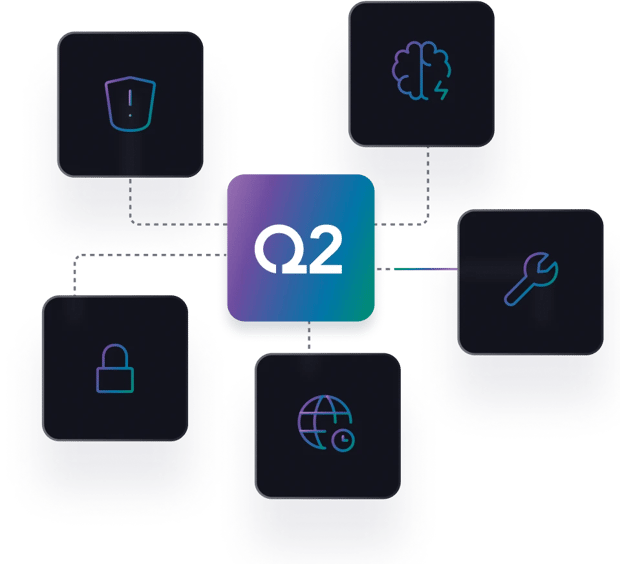
Security is interwoven through all aspects of the engineering environment. Our security approach focuses on five best practices that work together to deliver a highly effective level of security to financial institutions.
What is the multilayer security Q2 uses?
Q2 is a leader in digital banking security across applications, infrastructure, and data. We use a range of techniques and technologies—zero trust, behavioral analysis with anomaly detection, endpoint interrogation, artificial intelligence (AI)/machine learning, blockchain, transaction risk management, and much more.
How does Q2 support continuous availability?
Q2 is focused on providing always-available, uninterrupted digital banking. To support this effort, we utilize active hosting and a distributed cloud architecture to ensure maximum performance and protection.
Future-proof protection with CSMA
Q2 adheres to a CSMA strategy that relies on an ecosystem of tools and controls to secure a distributed digital banking environment. The technology is in place at Q2 to secure many complex environments.
-
What is CSMA?
Q2’s CSMA approach is one in which one security tool detects a threat and informs the others, with AI often used to determine and execute the best response. The result is reduced administration complexity, fewer mistakes, increased visibility, and a better coordinated, automated threat response in real time. Moreover, the tools can be updated and administered from a central plane.
Learn more about CSMA from Q2 Chief Availability Officer (CAO) Lou Senko.
How does Q2 detect and prevent fraud in real time?
Q2's behavioral analysis with anomaly detection, endpoint interrogation, zero-trust perimeter protection, and more can offer fraud prevention in real time.
How does Q2 protect data?
Q2 uses blockchain, active disaster recovery, and a distributed cloud to provide data privacy, uptime, and reliable workflow processes.
Stay ahead of smart fraudsters:
Protecting PCI data with blockchain technology
Q2 TrustView, using ALTR technology, mitigates the breach of PCI data in real time and aims to safeguard that critical data by fragmenting it across a private, low-latency blockchain network. Our blockchain solution is designed to ward off cyberattacks from multiple servers focused on centralized data points.

How does Q2 secure a growing fintech integration environment?
Q2’s CSMA strategy will greatly reduce security threats in a digital banking world of increased fintech partnerships and complicated infrastructure.
Can Q2 stop fraud before it happens?
We don’t believe in waiting for incidents to happen. In fact, one third of issues are proactively detected and resolved by Q2 support engineers. Through our state-of-the-art Integrated Operations Center (IOC), we proactively monitor our clients’ platforms across five key areas, 24/7/365.
Security from a recognized leader
Q2 has been recognized as a data security leader by the respected CSO Magazine for our decades of expertise and outstanding security track record.
- $1B in suspicious transactions identified by Q2 Sentinel in 2023 that our FIs chose not to process after human review.
- >$1.4B in fraud stopped by our positive pay solution, Centrix ETMS, in 2024.
- 99.9% Availability
NIST Level 4 Maturity Rating Adaptive/Resilient
Q2’s cyber/information security capabilities are both mature and adaptive towards new cyber risks and evolving threats. Adaptive cybersecurity programs are more resilient towards destructive cyber attacks.
“In addition to Q2’s Centrix ETMS positive pay, we use Q2 Sentinel, another risk mitigator embedded in our digital banking. Together, they provide a lot of information for our fraud department and customers. When the system flags a transaction, the customers will say, ‘Oh, wow, you really are watching.’ They know we take their security very seriously.”
VP and Business Solutions Manager
Q2 security products
Q2 leverages AI and machine learning in additional products to further deter criminals in the always-on digital banking world.
-
Q2 Patrol
Adds an additional layer of monitoring by leveraging user behavior and device details to identify suspect sessions which then require additional authentication.
-
Q2 Sentinel
Monitors and analyzes transactional and user data in real time to identify and suspend suspicious transactions before they take place.
FAQs
How does Q2 protect financial institutions from fraud?
Q2 combines behavioral analysis, anomaly detection, endpoint interrogation, zero-trust perimeter protection, and AI/machine learning to detect and prevent fraud in real time. Products like Q2 Sentinel monitor transactional data continuously, and Q2 Patrol adds session-level monitoring with additional authentication for suspect activity.
What is cybersecurity mesh architecture (CSMA)?
CSMA is a security strategy where multiple tools and controls work together across a distributed environment. When one tool detects a threat, it informs the others, and AI determines the best response. Q2 uses CSMA to coordinate security across its distributed digital banking platform.
How does Q2 monitor for security threats?
Q2's Integrated Operations Center (IOC) monitors all infrastructure 24/7/365. One third of issues are proactively detected and resolved by Q2 support engineers before they impact the financial institution.
Resources
Learn more about the Q2 platform
-
Q2 Distributed Cloud Architecture
Learn more about an architecture that allows your FI to compete with bigger banks.
-
Q2 Data & Machine Learning
Deep insights to effectively predict fraud and keep data-at-rest from bad actors.
-
Q2 Extensibility
Easily build the customizations your FI wants.
Security Vulnerability Disclosure
If you believe you have discovered a vulnerability, privacy issue, exposed data, or other security issues on our website or in a product, we want to hear from you.